A bright, warm afternoon in late October 1958, in rural Monroe, North Carolina: two Black children, nine-year-old James Hanover Thompson and his eight-year-old friend David “Fuzzy” Simpson, were playing with a group of white boys and girls in the yard next to one of the white children’s homes. Jim Crow laws were rigidly enforced at the time, but it was not unusual for Black and white children to play together when their separate, segregated schools let out for the day. They knew each other. The mothers of the Black children cooked and cleaned for the mothers of the white children.
As afternoon gave way to evening that day, October 28, and some of the children left, a kissing game began. One of the white girls, seven-year-old Sissy Sutton, kissed first David on the cheek, and then James, before heading home. Retrieving their wagons, which held a stash of empty bottles they hoped to sell, the two friends walked toward the center of town. They had no way of knowing they’d done anything wrong, and that white Monroe was about to severely punish them, and their families—for a kiss.
Sissy Sutton mentioned the kiss to her parents when she got home. James’s mother had worked for Sissy’s mother; his grandmother had worked for Sissy’s grandmother. Reportedly in hysterics and threatening to kill James, Sissy’s mother notified police. Rumors raced through the white community. Sissy’s father grabbed his shotgun and, joined by a mob threatening a lynching, he crossed the railroad tracks that divided Monroe’s white and Black neighborhoods. The Thompsons’ house was dark. The mob would have killed them if the police hadn’t gotten there first, Mr. Thompson told EJI, recalling “They would have shot us. They was mad, they was gonna kill us.” James’s mother, Evelyn Thompson, would also tell a reporter months later that “some white people in Monroe” had warned her “that my family would be killed if I didn’t get out of town.”
James and David were pulling their wagons when police accosted them, with guns drawn. Shouting racial epithets and calling them “little rapists,” police handcuffed the boys and shoved them into a patrol car. “When we got down to the police station, we understood that they said we had raped a little white girl,” James Thompson would recall more than half a century later. “They took us down in the bottom of the police station to a cell … They started beating us, they were beating us to our body, you know? They didn’t beat us to the face where nobody could see it. They just punched us all in the stomach and back and legs. We couldn’t understand why grown people was beating us up, but we didn’t have nobody to defend us. We was hollering and screaming. We thought they were going to kill us.” Their cries were only met with “shut up back there!” Mr. Thompson told EJI.
For the next six days they were kept locked up and barred from seeing their parents. Police entered their cell on Halloween, pretending to be Klansmen. “These men came with sheets over their heads,” Mr. Thompson would recall later. “They said they were going to hang us, lynch us. I was crying. I was scared to death.”
So began the infamous “Kissing Case,” as it came to be called, a case that shined an international spotlight on the bigotry and racial injustice in the South. The lives of James Thompson and David Simpson and their families were shattered and the entire Black community was traumatized, but as the spotlight shifted, with the exception of a television interview with Oprah Winfrey in 1993 and a 2011 interview for StoryCorps and NPR, the Kissing Case all but disappeared from public view.
“It’s been swept under the rug,” James Thompson’s younger brother, Dwight “Dee“ Thompson, 62, said in a 2023 interview with EJI, revisiting the Kissing Case as the 65th anniversary approached. “They just tried to move on, even the city, just tried to move on … People going to church together, people working in the community … The town was divided because of the Kissing Case [but] you had to go work for these people, Black folks worked for the white folks … Everybody go along to get along. Don’t talk about the Kissing Case, just keep moving, that’s a thing of the past,” recalled Dwight Thompson. “It’s history—American history. It’s shameful history.”
A “separate but equal” hearing, a burning cross on the lawn
The boys were charged with assault and molestation. A juvenile court judge, J. Hampton Price, prepared to hear the case—but first he contacted the Morrison Training School in Hoffman, North Carolina, to secure places for the boys. The reformatory was founded as the State Training School for Negro Boys and renamed for Cameron Morrison, a North Carolina governor who had been a leader of the white supremacist Red Shirts.
Judge Price held his first hearing with just Sissy Sutton and her parents, thus denying the boys their right to confront their accuser. Then he held what he called a “separate but equal” hearing, and without attorneys there to defend them, or their mothers allowed to attend for support, he ruled the boys were guilty. He would later cite the boys’ silence when confronted with the charges as an admission of their guilt. On November 3, the judge sentenced the boys to spend the rest of their childhoods at the Morrison school. They would be eligible for release when they turned 21.
Within days, Evelyn Thompson’s white landlord sent her an eviction notice. Mrs. Thompson and David Simpson’s widowed mother, Jennie Simpson, were fired from their $15 a week jobs as domestic workers.
At night, shots were fired at the family home, Mr. Thompson told EJI. “My mom and them, they would go out in the morning and sweep bullets off the porch,” James’s older sister, Brenda Lee Graham, recalled in the StoryCorps interview.
Evelyn Thompson didn’t sleep. “She would be up walking the floors and praying,” Ms. Graham said. She also remembered “that at night you could see them burning crosses … right down the front yard.”
Someone even killed James’s dog.
“They ran our family out of town,” Dwight Thompson told EJI. The NAACP moved both families into public housing in Charlotte for their own safety. “We were kind of happy that we were getting out of there,” Brenda Lee Graham told EJI. “We wouldn’t have to be terrorized anymore at night, scared to sleep. Mama used to sit up [at night] and look out the windows. That’s where Dwight was born, in 1961. “After everything that happened,” he said, “my mother had the audacity to have another child.”
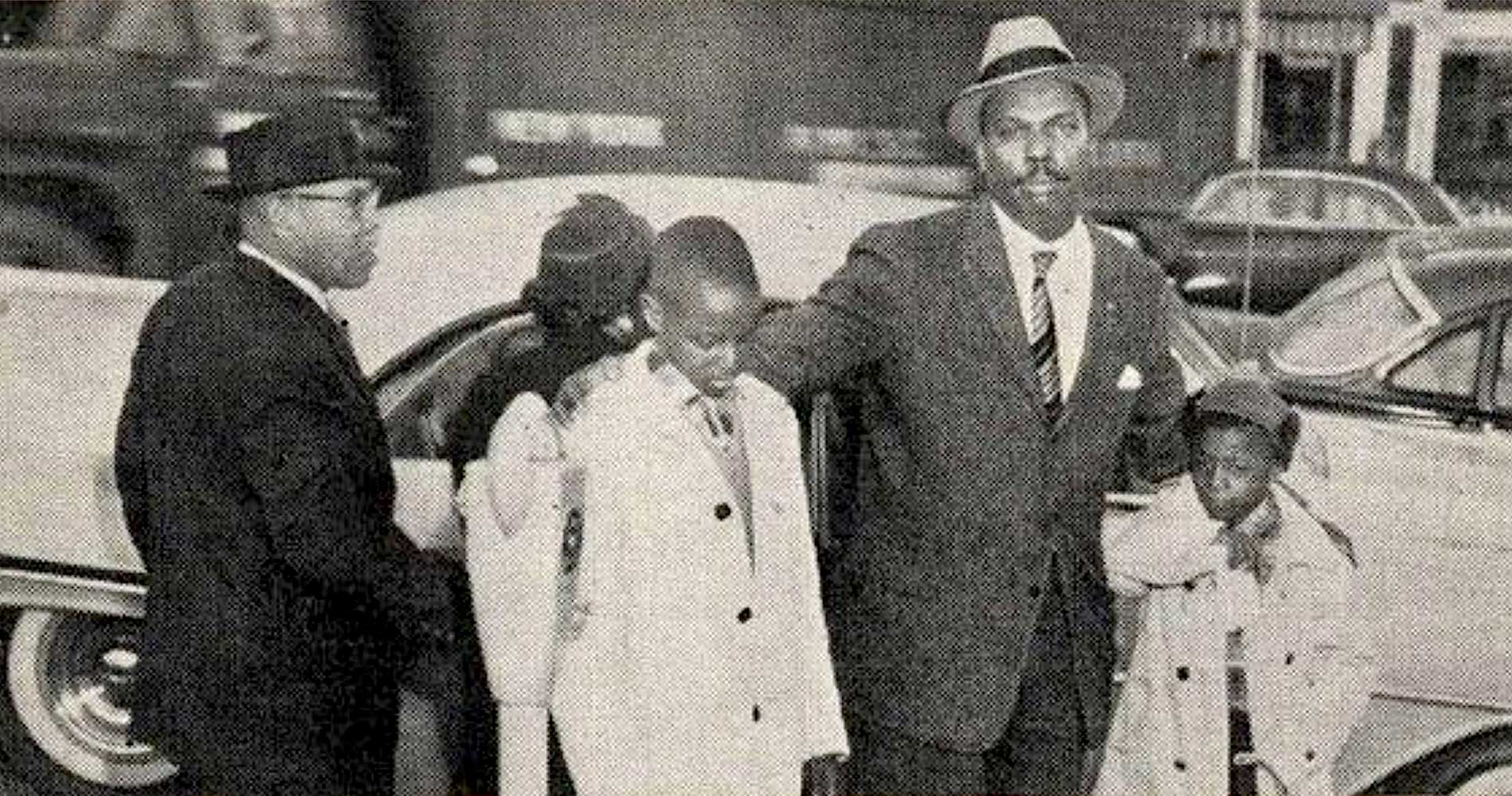
Kelly Alexander, of the Wadesboro, North Carolina, NAACP, comforts James and David following an unsuccessful habeas corpus hearing. (Jet Magazine)
The secret story gets out
None of Monroe’s three newspapers or any of the state’s white newspapers covered the hearing or, initially, any of the events surrounding the Kissing Case. James and David might have spent years at the Morrison school but for the involvement of Robert Williams, the president of Monroe’s NAACP, who took up their cause, and Ted Poston, a Black reporter for the New York Post, who agreed to write about the case.
On November 10, Mr. Poston’s story—which included the detail that the two boys had been threatened with lynching—ran on the Post’s front page. A Black civil rights attorney from New York, Conrad Lynn, got in touch with Robert Williams, offering to represent the boys.
Mr. Williams had already drawn the ire of white residents in Monroe. Weeks before the kissing episode he had petitioned, unsuccessfully, for his children to attend the segregated public elementary school. The previous year, he’d tried, and failed, to get Monroe to integrate its public swimming pool for even one day a week. Black children had drowned in local swimming holes and creeks, but officials said desegregation would be too costly because they would have to drain and clean the pool after Black swimmers used it.
Thanks in part to Mr. Williams’s efforts, newspapers elsewhere began picking up the story of the Kissing Case. Joyce Egginton, a reporter for the London News-Chronicle, traveled to Monroe. Accompanied by the boys’ mothers, along with Robert Williams and Conrad Lynn, the London reporter, posing as a social worker and with a camera concealed under a fruit basket, visited James and David at the reformatory. Mr. Thompson recalled to EJI that his mom had only been allowed to visit the one time.
On December 18, her story and a photo of the boys with their mothers ran on the News-Chronicle’s front page. Papers across Europe picked up the story, sparking an international campaign aimed at winning the boys’ freedom. Thousands of schoolchildren in the Netherlands sent letters to North Carolina Gov. Luther H. Hodges. Clergy on both sides of the Atlantic protested. So did union members and college students in the North.
The NAACP appealed the case in North Carolina courts. On January 12, 1959, state superior court judge Walter Johnston presided over a two-hour hearing at which both boys and their mothers were present, along with their lawyer, Conrad Lynn, who argued for their innocence. In his testimony, Judge Price twice referred to the boys with the n-word, according to the Winston-Salem Journal. David fell asleep, with his head on his friend James’s shoulder, waking up to hear Judge Johnston say he was sending both boys back to the reformatory. The judge said he had heard no evidence that the boys should not have been convicted. Newspapers reported that David and James both cried.
A Black newspaper, The Carolinian, ran a photo of both mothers in tears as they left the courthouse, where a statue of a Confederate soldier towered near the entrance, captioned “In Despair.”
Embarrassed by worldwide attention to the case, Gov. Hodges, Judge Price, and other white officials went on the offensive. They enlisted the state’s white media to publicly blame the boys and their mothers, and in violation of the requirement to protect juveniles’ privacy, they freely offered details they said had been provided by social service workers, teachers, and police. The said they were acting to correct “misinformation” and “inaccuracies” in the national and international media.
Officials branded James and David as “incorrigible” and “wayward” delinquents with irresponsible mothers. They said the boys had been sent to the reformatory for their own good, claimed Mrs. Thompson “has a bad reputation” in her community, and charged that Mrs. Simpson’s children were often in trouble with police. Local and state news outlets repeated those officials’ words in articles that showed little concern about accuracy.
“This is my family’s history,” Dwight Thompson told EJI. The local and state mainstream media coverage, which he reviewed as part of his own research, did not portray the mother who had raised him. “My mother is my hero. I can’t imagine what she endured,” recalled Dwight Thompson. “She was a good person, kind as she could be. Give you the coat off her back,” Brenda Lee Graham told EJI.
When asked about what their mother was like, the Thompson siblings remembered her as a wonderful, loving woman who fed the homeless and always had a dollar to help a friend in need. She was a praying woman who took her family to church seven days a week and made every family celebration a good time, baking jelly roll cakes on the siblings’ birthdays. She would also make “killer fried chicken” and pecan pies on Sundays.
Led by Black journalists, national media attention continued to spread and on February 13, 1959, bowing to public pressure, Gov. Hodges—who went on to become U.S. Secretary of Commerce—pardoned the boys. Released from the reformatory, they joined their families, who had been relocated by the NAACP to public housing in Charlotte.
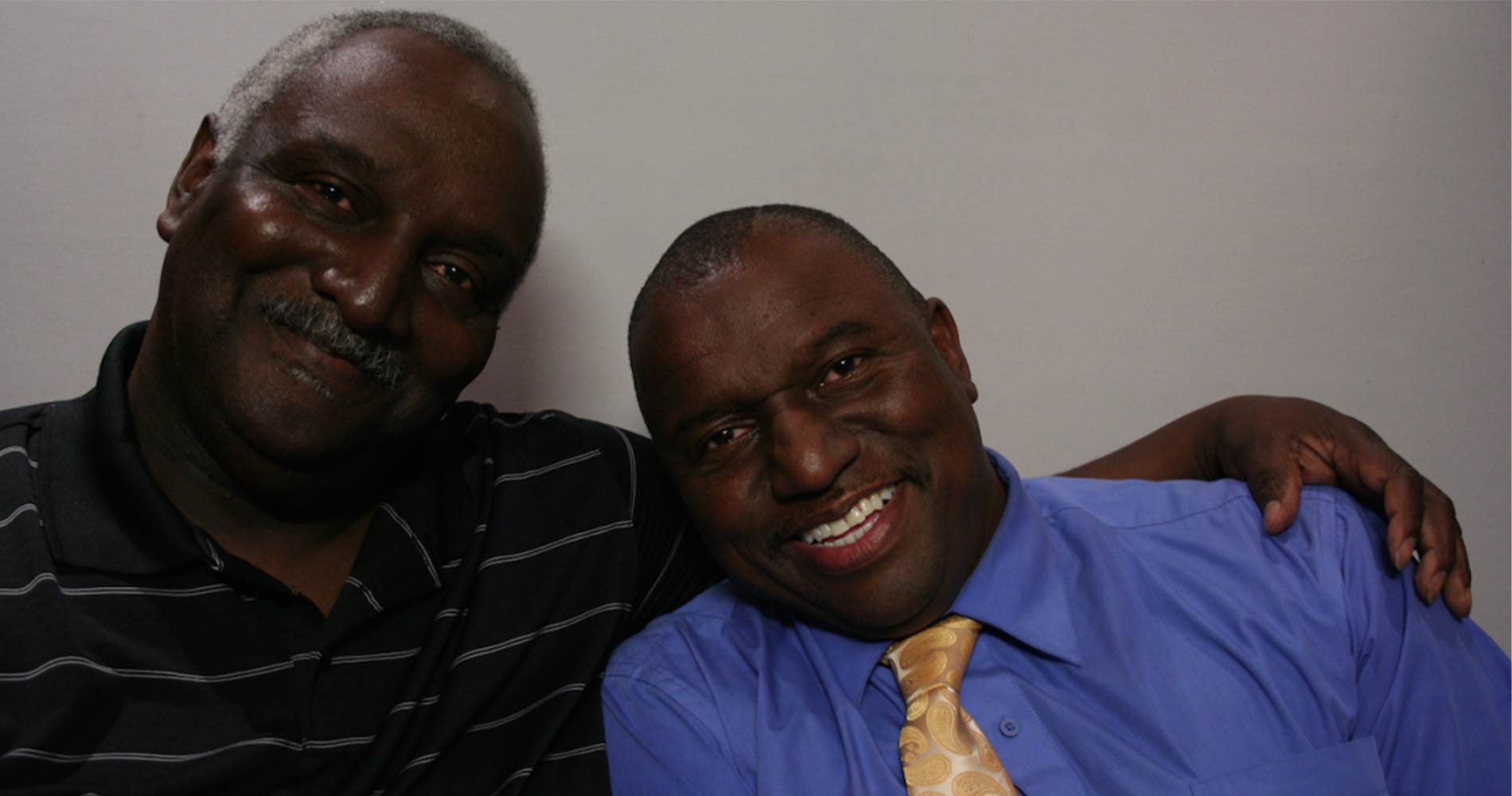
James Hanover Thompson (left) and his brother Dwight Thompson in 2011. (StoryCorps)
“We should sterilize you”
A couple days later, an AP reporter interviewed both mothers in Charlotte. All the boys had been doing on that October afternoon, Mrs. Thompson said, were innocent things—“raking leaves for a white lady,” a game of “cowboys and Indians” with their friends, and “playful-like” kisses on the cheek. But that night a policeman came to the house and told her James had been arrested. “We haven’t had much peace since it happened,” she said.
The media spotlight quickly moved on, but the stigma remained for both boys.
David Simpson said a police sergeant from Monroe told Charlotte police to look for him whenever crimes occurred. “I was never able to get out of the system,” he told Oprah Winfrey in 1993.
James Thompson remembered the words of the state psychologist he was required to visit weekly in Charlotte after being released from the state reformatory. “He said, ‘What are you, some kind of maniac? We should sterilize you.’”
This was not a hollow threat. North Carolina sterilized more than 7,000 people between the 1920s and the 1970s. A recent study by scholars identified the Morrison Training School as one of the “feeder” institutions that sent children to be sterilized. Black people were sterilized in the 1960s at a much higher rate than white people, the study found.
After James returned home from Morrison, his sister, Brenda Lee Graham, recalled during the StoryCorps interview, “It was like seeing somebody different that you didn’t even know. He never talked about what he went through there. But ever since then, his mind just hadn’t been the same.”
Both boys were repeatedly arrested and incarcerated as they got older.
James said to his brother Dwight, who interviewed him for StoryCorps, “I always sit around and wonder if this hadn’t happened to me, you know, what could I have turned out to be? Could I have been a doctor? Could I have gone off to some college or some great school? It just destroyed our life.”
“I still feel the hurt and the pain from it,” James told his younger brother. “And nobody ever said, ‘Hey, look, I’m sorry what happened to y’all. It was wrong.’”
Mr. Thompson told EJI that the incident left him fearful, especially when visiting Monroe.
Still today, no one—no local or state officials or the media—has ever apologized to Mr. Thompson or Mr. Simpson or their families, or compensated them for violating their rights. “We should have been compensated for what happened to us, what happened to our families, destroyed our families—running us out of town, shooting up our dogs, wrongfully convicted. We need to be apologized to for what we went through,” Mr. Thompson told EJI.
Sissy Sutton never spoke about the kiss publicly. In 1993, Oprah Winfrey asked Mr. Thompson and Mr. Simpson, “Do you blame her?”
Both men responded immediately that the little girl should not be held responsible. “I don’t blame her,” Mr. Thompson said. “We were kids, kids do innocent things.” When EJI spoke with Mr. Thompson, he expressed the same sentiment that, all these years later, he still did not blame the little girl.
“It wasn’t her fault,” Mr. Simpson said. “Children [are] only taught what their parents feed them.”
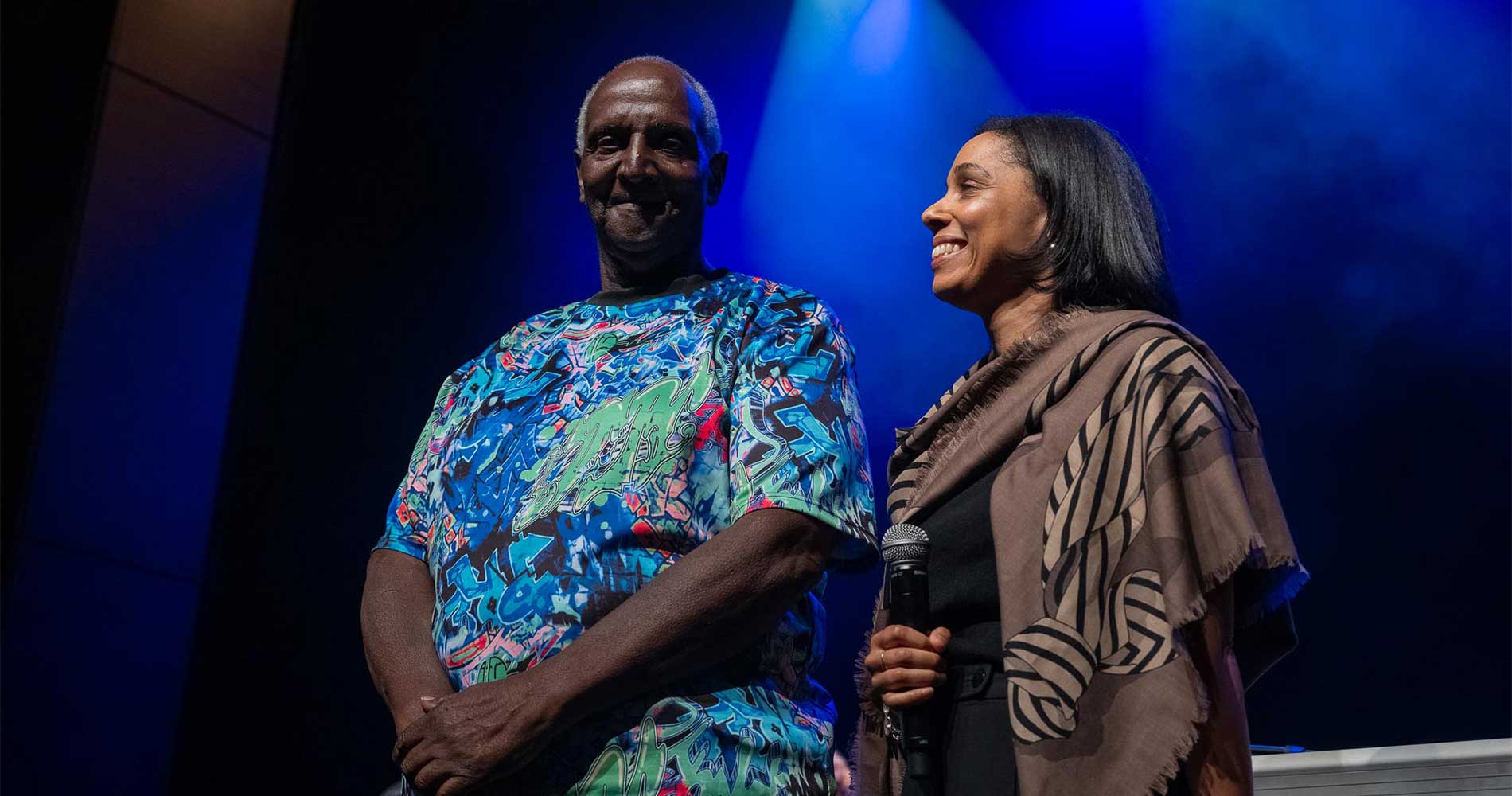
James Hanover Thompson and EJI Senior Attorney Sia Sanneh during EJI’s Juneteenth celebration in Montgomery, Alabama, on June 19, 2024.