Anthony Crawford was a prosperous 56-year-old Black planter in Abbeville, South Carolina, who helped start a church, a school, and farms for his community, and was the patriarch of his family. After daring to insist that a white merchant pay him a fair price for his cottonseed, he was stabbed, beaten, hanged, and shot more than 200 times by a mob of 300 white men, in view of hundreds of eyewitnesses, on October 21, 1916.
Two days later, white residents of Abbeville “voted” to expel Mr. Crawford’s widow and 13 children from the area and seize their property. South Carolina’s governor declared that he could not protect the Crawfords from violence. Terrified, they fled to New York, Illinois, and other far-off places, fragmenting the once-strong family. It would take efforts over generations, and the persistence of elders in passing on the story of Anthony Crawford’s life and death, to repair those bonds.
A century after Mr. Crawford was murdered, on October 21, 2016, more than 100 of his descendants returned home from across the country to join EJI Executive Director Bryan Stevenson and hundreds of other supporters—clergy, students, community members—in honoring and remembering Anthony Crawford. They commemorated him by collecting soil in jars from the public square where he was lynched—where the mob had left his body hanging from a tree for days.
Community members photograph the marker in Abbeville that honors and remembers Anthony Crawford.
Juan Carlos Castaneda/Human PicturesIn a park named for Confederate President Jefferson Davis, alongside a stone monument to slavery defender John C. Calhoun, and within steps of a memorial bearing an inscription hailing the “right cause” of the Confederacy, they unveiled a new historical marker that tells the truth of Anthony Crawford’s murder in the place where it occurred.
EJI has documented more than 6,500 racial terror lynchings in America between 1865 and 1950; more than 240 were in South Carolina, at least 11 in Abbeville County. Nearly all the perpetrators, including Mr. Crawford’s, went unpunished. To this day, some Black families discuss loved ones lost to lynchings only in whispers.
“We’re representing a whole slew of people who are too traumatized to speak,” said Mr. Crawford’s great-great-granddaughter, Doria Johnson, who had traveled to Abbeville from Chicago.
“For a long time, the Earth has been silent about the injury and injustice of what happened to Anthony Crawford,” said Mr. Stevenson, who officiated at the ceremony. “But today we’re going to resurrect the truth … We are here to witness what can happen when we come together and say, ‘We are here!’”
The chant went up in Jefferson Davis Park: “We are here! We are here!”
Mr. Crawford’s marker was one of the first to publicly acknowledge a lynching at the site of the killing. Now there are over 140. More are planned.
The markers and jars of soil are the work of EJI’s Community Remembrance Project, a partnership with community coalitions nationwide to honor lynching victims locally. In a country still littered with monuments and memorials to defenders of slavery, the markers are building local knowledge and a physical landscape that more accurately reflects the truth about the racial terror era.
Visitors at the Legacy Museum are confronted with the legacy of racial terror lynching, represented by the hundreds of soil jars on display.
Juan Carlos Castaneda/Human PicturesThe first Community Remembrance Project marker, for William Miller, who was lynched in 1908 for organizing Black coal miners for better wages, was installed in Jefferson County, Alabama, in 2015. Since then, EJI has worked with hundreds of multi-racial, multi-generational coalitions to install markers in over 20 states, across the South but also in the North and West. More than 800 jars of soil have been collected and are displayed at the Legacy Museum. More than 900 high school students have written CRP racial justice contest essays.
“We cannot heal the deep wounds inflicted during the era of racial terrorism until we tell the truth about it,” Mr. Stevenson said. “The geographic, political, economic, and social consequences of decades of terror lynchings can still be seen in many communities today, and the damage created by lynching needs to be confronted and discussed. Only then can we meaningfully address the contemporary problems that are lynching’s legacy.”
CRP coalitions are telling this American history publicly at a time when government officials have set out to distort and erase it and when cultural and educational institutions may be afraid to grapple with it.
The National Memorial for Peace and Justice is part of EJI’s Legacy Sites in Montgomery, Alabama.
Juan Carlos Castaneda/Human PicturesWhen EJI’s National Memorial for Peace and Justice opened in 2018, it was the first public memorial to honor the thousands of Black lynching victims in America. Visiting the memorial is often the spark behind the formation of a local coalition. Coalition members include descendants, community activists, teachers, students, ministers, rabbis, veterans, historians, librarians, and artists.
Not Just a Marker
Years of effort go into each marker and soil collection ceremony. Working with EJI researchers and lawyers, coalitions connect with descendants, build public support, and gather detailed accounts of racial terror lynchings. CRP coalitions are generally organized by county. Many hold racial history workshops and discussion groups aimed at healing. Others create racial justice plays or films (EJI produced one about Anthony Crawford and his descendants) aimed at raising public awareness.
In Louisiana, the Lafayette Parish Community Remembrance Project erected a marker in 2025 honoring lynching victims Louis Senegal and Antoine Domingue. The alliance of 15 local groups was founded by Fred Prejean, a Black former Marine reservist and civil rights activist, and Ian Beamish, a white history professor at the University of Louisiana at Lafayette. After Mr. Prejean’s death in 2022, his widow, Ola Prejean, a retired school psychologist, became the project’s co-leader. The coalition started a book club, screened Slavery by Another Name, a documentary on convict leasing, and campaigned to have a Confederate monument taken down.
Ms. Prejean spoke to an audience of some 60 people at the marker dedication. Her voice broke as she told of researching the lives of Mr. Senegal and Mr. Domingue, and of realizing that many people now living in the parish had those surnames and might be the victims’ descendants. She asked people in the audience with those names to raise their hands and be acknowledged. Senegal? Several hands went up. Domingue? Several more.
In Cleveland in 2025, the Black Environmental Leaders coalition erected a marker honoring John Jordan, the 1911 victim of Cuyahoga County’s only documented lynching. The group also organized trips to EJI’s Legacy Sites in Montgomery, Alabama. “Today is a manifestation of five years of work,” coalition co-executive director SeMia Bray said at the marker unveiling. “Lasting progress is possible when communities build power, speak truth to power, and create coalitions that shift the balance of power.”
Telling the History, Adding the Context
Marker texts make clear that lynchings were intended to subjugate and terrorize Black communities. The Orange County, Florida, marker for July Perry and other victims of the 1920 Election Day Massacre tells how a white mob burned Black homes and churches in Ocoee and drove out all the town’s Black residents within a year of the massacre, forcing them “to abandon or sell land and homes they owned.” The massacre began when Black citizens tried to vote.
Community members gathered to unveil the marker honoring July Perry on June 21, 2019.
Kwasi CorreamThe texts describe the complicity of government and law enforcement: sheriffs who jailed Black citizens on mere suspicion, then stood aside when lynch mobs arrived; police officers who ignored or encouraged those mobs. The marker for Mr. Jordan’s 1911 lynching in Cleveland quotes the police lieutenant who said “it had to happen.”
The marker in Hamilton County, Chattanooga, Tennessee, honoring Ed Johnson says that in 1906, after an all-white jury wrongfully convicted him of assaulting a white woman, two courageous Black lawyers took his case. In an unprecedented action, they persuaded the Supreme Court to stay his execution. (His conviction was posthumously vacated in 2000.) It didn’t deter the mob of white men in Chattanooga.
Two nights after the stay was issued, they dragged Mr. Johnson from jail, shot him over 100 times, and hanged him from a bridge in the heart of town before a cheering crowd. Mr. Johnson’s lawyers were run out of town.
Like all CRP markers, Mr. Johnson’s provides context. “Almost 25% of lynchings involved allegations of inappropriate behavior between a Black man and a white woman that was often characterized as ‘assault,’” it reads. “These accusations were often based on merely looking at or accidentally bumping into a white woman; smiling, winking, or getting too close.”
Community coalitions work to correct false public histories. For decades, the death certificate for 19-year-old George Tompkins, who in 1922 was found lynched in Indianapolis with his hands tied behind his back, said “Suicide.” But at the request of the Indiana Remembrance Coalition, the Marion County coroner reviewed the death and in 2022 ruled it a homicide.
Several Indiana residents created the interracial coalition after visiting EJI’s lynching memorial. They researched Mr. Tompkins’s lynching, erected a headstone at his unmarked grave, and in partnership with EJI, erected his marker. At the 2025 unveiling, coalition member Karen Christenson said it was “our—white people’s—ancestors, who did these awful things.”
In Coshocton County, Ohio, research by a remembrance coalition called Coshoctonians for Peace and Equality shed new light on the gruesome 1885 lynching of Henry Howard. In preparations for Mr. Howard’s marker, coalition co-founder Lucy Malenke interviewed Lula Sheffield Williams, 100, a Black woman who had lived in Coshocton her entire life. Ms. Williams remembered the Coshocton jeweler who displayed Mr. Howard’s severed toe in a jar until well into the 20th century.
As Mr. Howard’s marker says, he was arrested after a white man spotted him outside a tavern and “presumed him guilty” of alleged assaults on two white women. The next night, “nearly 200 armed and masked men” marched on the jail, abducted Mr. Howard, and hanged him on the county courthouse square as a thousand or more white people cheered.
Spectators at Mr. Howard’s lynching included “public officials, pastors, respected businesspeople, and parents,” explained Javanna Ramsey, the other co-founder of Coshoctonians for Peace and Equality. “This story needs to be reckoned with if people of color are ever going to feel truly safe and fully welcome in this place,” she said at the marker’s 2022 dedication.
Surviving Racial Terror, Inspiring Others
Mamie Lang Kirkland was seven when a white mob’s threat to lynch her father and his friend John Hartfield forced her family, along with Mr. Hartfield, to flee Ellisville, Mississippi, in 1915. They were among the six million Black citizens who left the South as refugees from racial terror, heading to the North and West in search of safety.
Later, against Mamie’s father’s warnings, Mr. Hartfield returned to Ellisville. He was lynched by white men in 1919. Hearing of this as a young girl, Mamie vowed not to go back.
Nearly 100 years later, her son, Tarabu Kirkland, showed her a 1919 newspaper headline reprinted in EJI’s lynching report: “John Hartfield Will Be Lynched at 5 O’clock This Afternoon.” “That’s the man,” she said, and memories poured forth.
Ms. Kirkland returned to Ellisville in 2015 with her son and her daughter-in-law, Nobuko Miyamoto. They prayed at the site where Mr. Hartfield, wrongly accused of assaulting a white woman, was lynched before thousands of spectators. Tarabu Kirkland reflected, “If the persons responsible were brought to justice, you would need a courtroom that could accommodate 10,000 people.”
Mamie Lang Kirkland at the EJI benefit in 2016.
Ozier MuhammadIn a documentary, Ms. Kirkland explained how her family settled in East St. Louis, Illinois, only to be driven out by murderous white mobs in 1917, and terrorized by the Ku Klux Klan after moving to Ohio. Ms. Miyamoto said Ms. Kirkland’s story reminded her of her own parents, who were among 120,000 Japanese Americans forced into internment camps during World War II.
At age 108, Ms. Kirkland spoke at EJI’s 2016 benefit dinner in New York City, exhorting young people—which at her age, she remarked, meant everyone—to continue the work of truth telling.
Moments of Comfort and Connection
On June 6, 2026, Eliza Jane Franklin pulled the blue cover off the new marker honoring her great-grandfather, William “Willie Lee” Jenkins, a Black World War I veteran who was lynched near Eufaula, in Barbour County, Alabama, for allegedly insulting his white employer’s wife. Several dozen people came to the unveiling. Someone asked Ms. Franklin, a historian and educator, to read the marker text aloud.
She took a breath and began: “On January 10, 1922, a mob of white people … abducted Mr. Jenkins, tortured him….” In tears, she struggled to continue. A white man in the audience, perhaps in his 70s, stepped forward and wrapped his arms around her. He stood beside her as she gathered herself and resumed reading.
“The mob slashed the back of one of his legs and fired several shots as he fled. He fell to the ground and, while wounded, was shot again in the back of the head…”
Listeners wept as she read on. “The mob … threw Mr. Jenkins’s body into an abandoned well, and removed his shoes, placing them on the lawn of a local Black pastor to terrorize the Black community.”
Ms. Franklin later posted her reflections online: “This marker represents more than one man. It represents countless families who inherited stories, grief, questions, and resilience. It is a testament to what can happen when descendants choose truth over silence and remembrance over forgetting.”
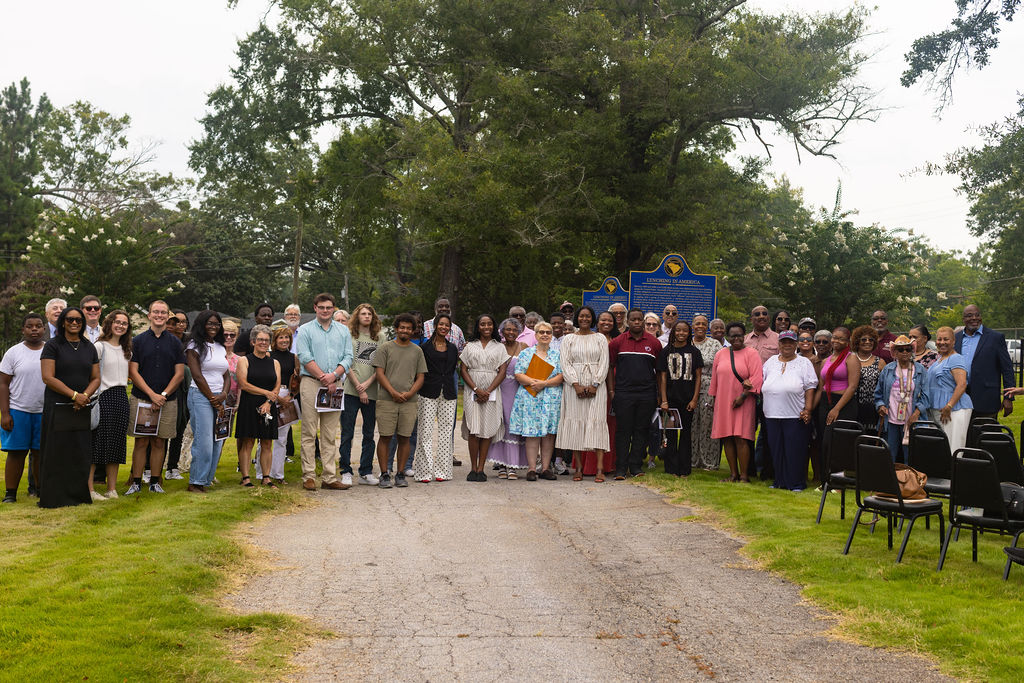
/
Community members gather in front of the newly dedicated historical markers to Robert Davis and Bennie Thompson in Greenwood County, South Carolina.
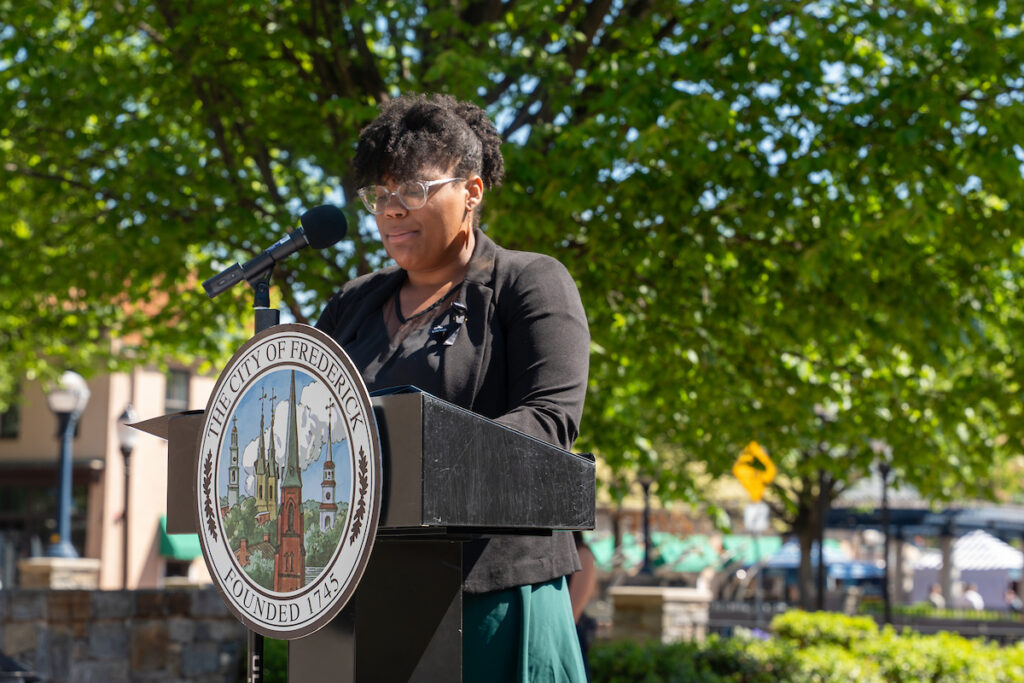
/
Mia Taylor, a member of EJI’s CRP team, speaks at the marker unveiling in Frederick County, Maryland.
The City of Frederick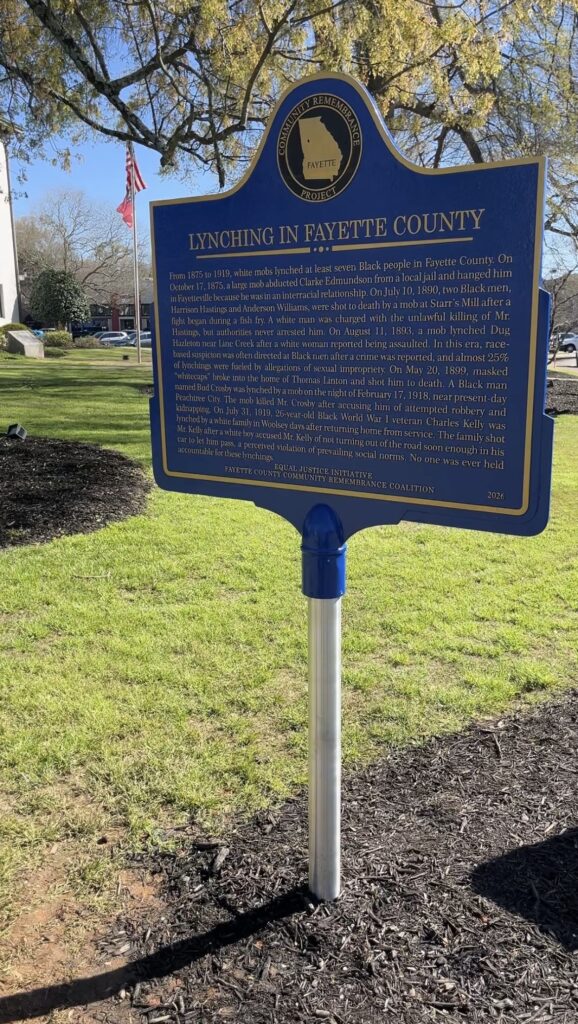
/
At least seven Black people were lynched in Fayette County, Georgia. Together, these victims are commemorated on this marker.
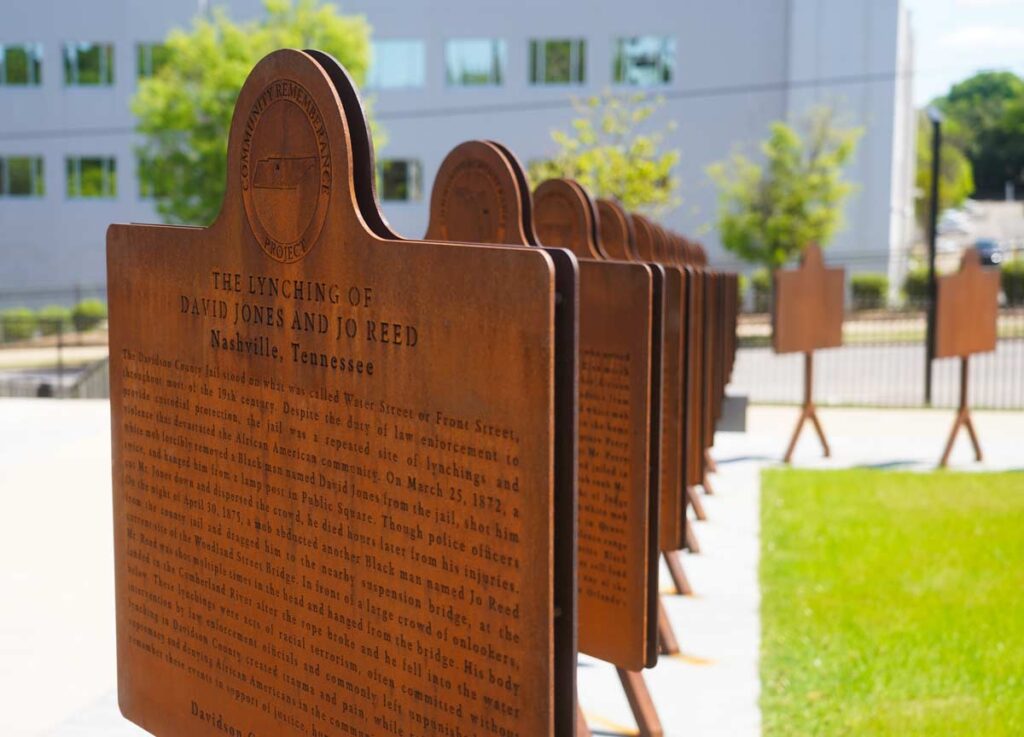
/
Duplicate markers are part of the National Memorial for Peace and Justice.
Bryan G. Stevenson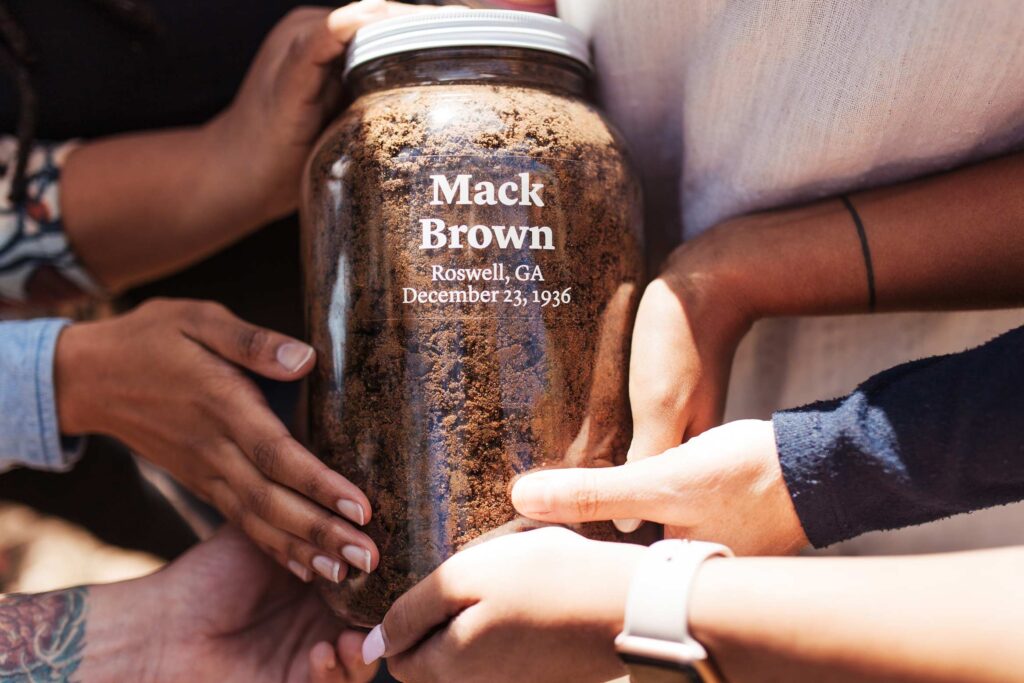
/
Community members collect soil in honor of Mack Brown.
Mr. Stevenson tells the story of the middle-aged Black woman who several years ago was alone collecting soil in a jar at a remote Alabama lynching site when a white man driving a pickup truck parked and climbed out. She was terrified. When he asked what she was doing, she explained. He offered to help.
As they knelt and dug together, a tear rolled down the man’s face. She asked what was wrong. He answered, “I’m so worried my grandfather helped lynch this man.” The woman comforted him. They prayed together—and delivered the soil to the Legacy Museum together.
“This Marker Is the Truth”
EJI honors CRP coalitions with an exhibit, “Community Reckoning,” at the National Memorial for Peace and Justice in Montgomery. Corten steel markers duplicating those at lynching sites surround Branly Cadet’s sculpture, Arise, which honors the people in those coalitions. The sculptor’s models were descendants of lynching victims.
Arise by Branly Cadet at the National Memorial for Peace and Justice in Montgomery, Alabama.
Bryan G. StevensonIn Abbeville, a new Confederate monument went up on private land in 2018. The public park there is still named for Jefferson Davis. But Mr. Crawford’s marker is still there, too, displaying the same photograph of Doria Johnson’s great-great-grandfather, in his coat and tie, that she saw at family gatherings growing up.
Ms. Johnson, who died in 2018, researched Mr. Crawford’s story for many years and told it around the world. “This marker is the truth,” she says in EJI’s film. “If you go to city hall to do business, if you go to the courthouse, you see Anthony Crawford. And he’s looking back at you.”