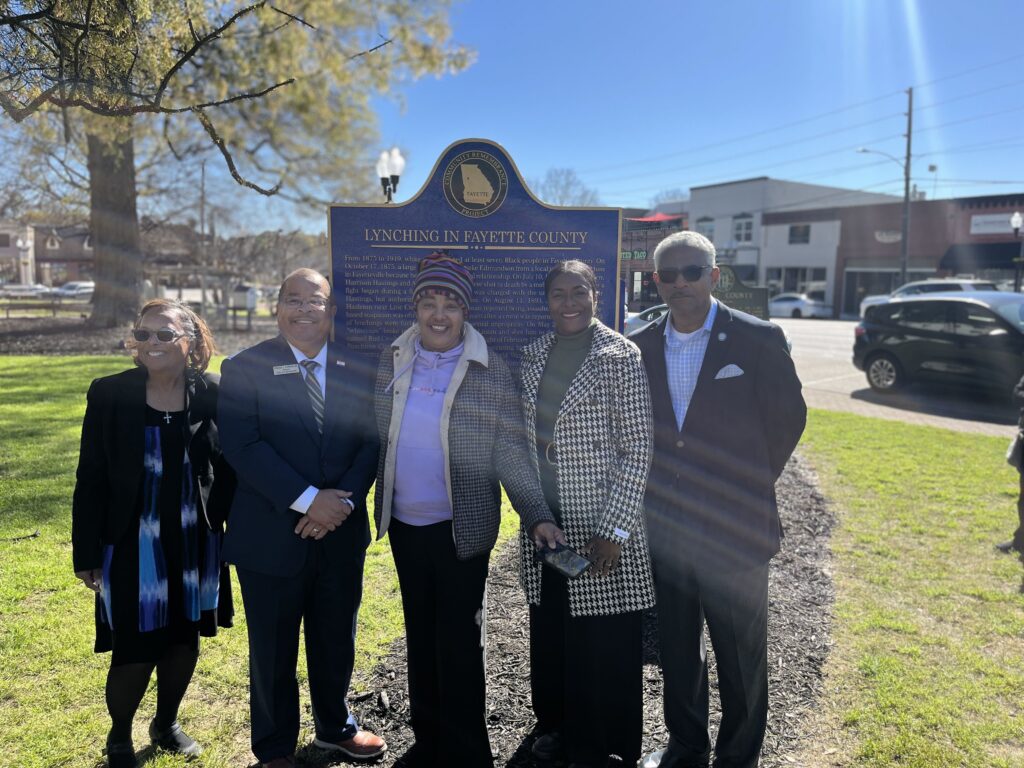
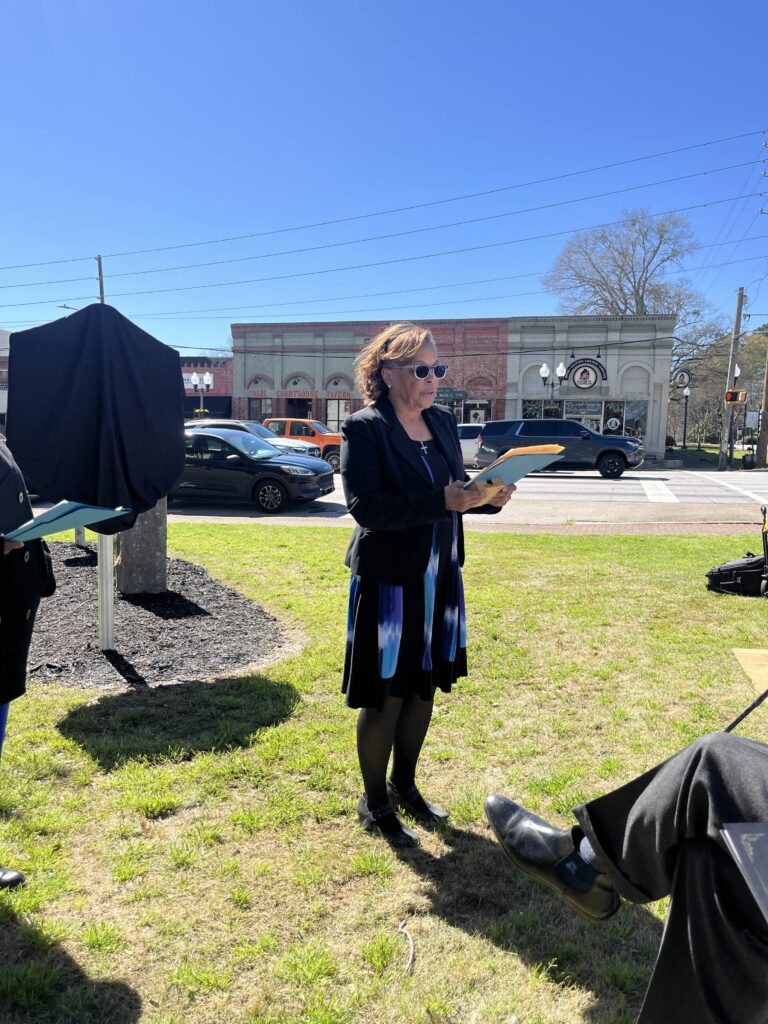
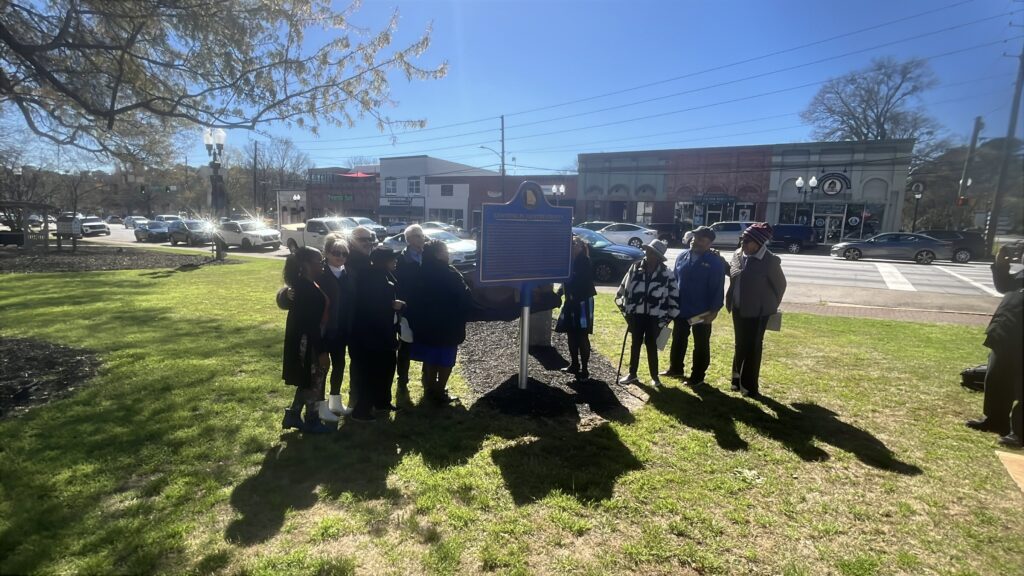
On March 12, dozens of community members and local officials gathered outside the old courthouse in the center of Fayetteville, Georgia, to dedicate a historical marker recognizing victims of racial terror lynching in Fayette County.
The marker is located in the center of Fayetteville, about 20 miles south of Atlanta, and reflects years of work in coordination with EJI. Since its founding in 2021, the Fayette County Community Remembrance Project has engaged the community in confronting its history of racial terror lynching with community soil collections from lynching sites.
Coalition co-chairs Janice Bryant and Tamika Smith opened the dedication ceremony and noted that recognizing this history is a step toward community healing and accountability. The coalition’s work is part of a broader network of remembrance initiatives across the country supported by EJI, they added.
“Today, we gather not only to unveil a marker, but to remember lives that were taken, acknowledge a painful chapter in our past, and confirm a commitment to truth, justice, and healing,” Ms. Bryant said.
The Rev. Edward Johnson, who is the first Black mayor of Fayetteville, offered an opening prayer on behalf of the city, expressing gratitude for the opportunity to reflect on the past while working toward a more just and unified future. He emphasized the importance of fellowship, compassion, and collective responsibility in creating stronger communities.
County Commissioner Charles Rousseau spoke about the power of publicly memorializing racial terror lynchings that were intended to intimidate and silence the entire Black community. Breaking that silence is an important step toward restoring dignity to victims and their families, he said.
“[R]emembering is not about dwelling in the past. It is about telling the truth about the past, so that our future can be different,” Mr. Rousseau said. “For generations many stories like these were ignored, minimized, or left unspoken.”
Connecting with local community coalitions across the country to help document histories of racial terror and installing historical markers to encourage education, remembrance, and reconciliation is a critically important part of EJI’s work, EJI Senior Project Manager Jennifer Harris said.
“To honor [FCCRC], a duplicate marker will be placed at the National Memorial for Peace and Justice in Montgomery,” she told dedication participants. “People around the world will know that people here in Fayette County have taken a stance to advance truth and justice.”
/
/
/
/
/
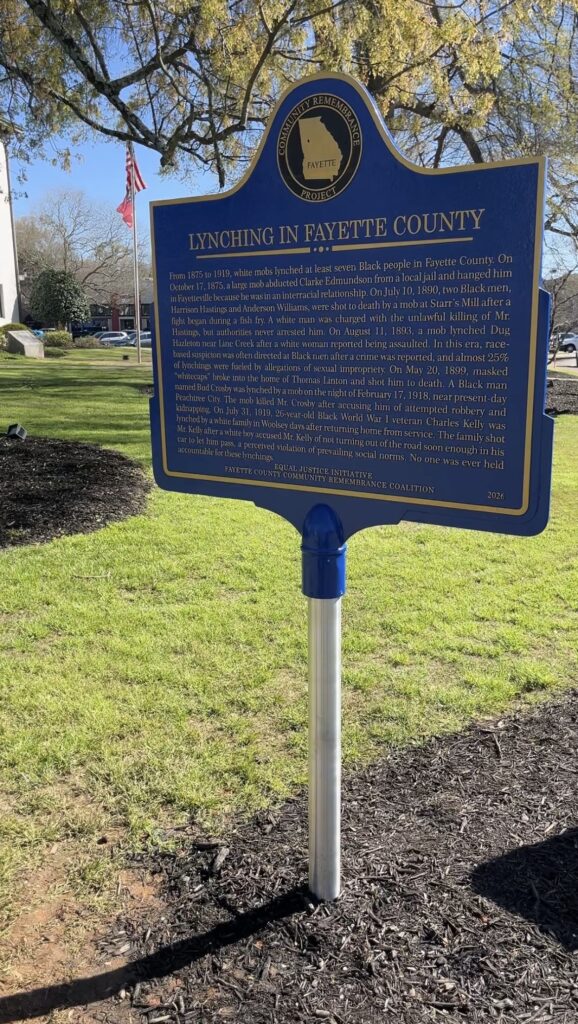
Lynching in Fayette County
From 1875 to 1919, white mobs lynched at least seven Black people in Fayette County.
On October 17, 1875, a large mob abducted Clarke Edmundson from a local jail and hanged him in Fayetteville because he was in an interracial relationship.
On July 10, 1890, two Black men, Harrison Hastings and Anderson Williams, were shot to death by a mob at Starr’s Mill after a fight began during a fish fry. A white man was charged with the unlawful killing of Mr. Hastings, but authorities never arrested him.
On August 11, 1893, a mob lynched Dug Hazleton near Line Creek after a white woman reported being assaulted. In this era, race-based suspicion was often directed at Black men after a crime was reported, and almost 25% of lynchings were fueled by allegations of sexual impropriety.
On May 20, 1899, masked “whitecaps” broke into the home of Thomas Linton and shot him to death.
A Black man named Bud Crosby was lynched by a mob on the night of February 17, 1918, near present-day Peachtree City. The mob killed Mr. Crosby after accusing him of attempted robbery and kidnapping.
On July 31, 1919, 26-year-old Black World War I veteran Charles Kelly was lynched by a white family in Woolsey days after returning home from service. The family shot Mr. Kelly after a white boy accused Mr. Kelly of not turning out of the road soon enough in his car to let him pass, a perceived violation of prevailing social norms.
No one was ever held accountable for these lynchings.
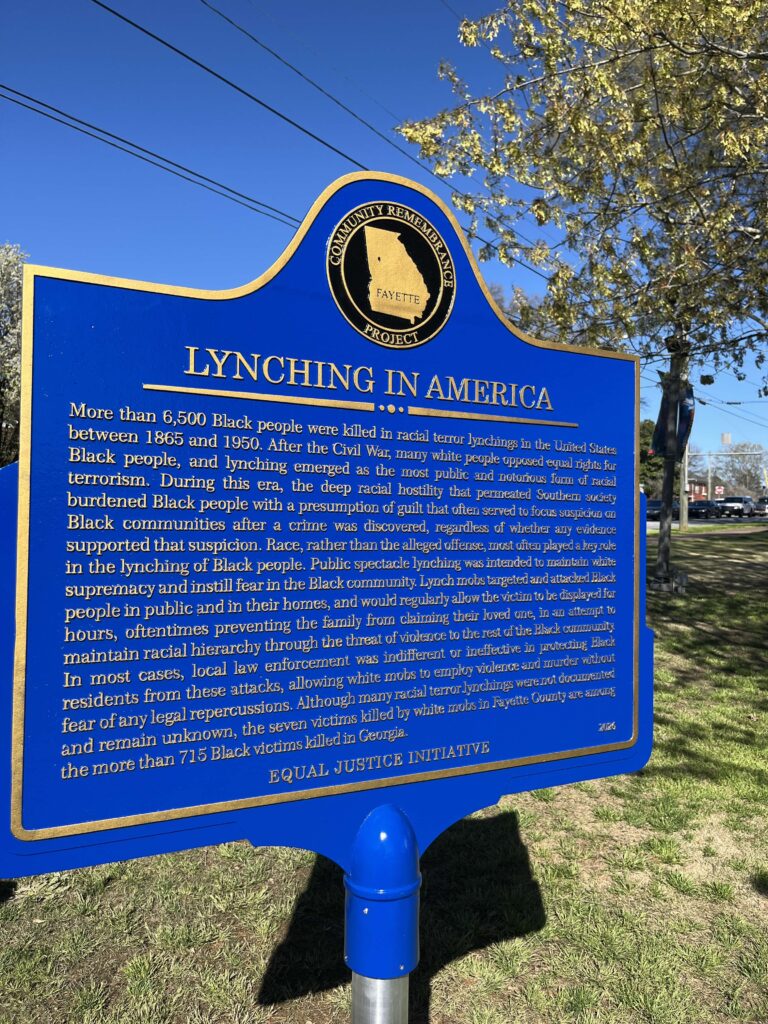
Lynching in America
More than 6,500 Black people were killed in racial terror lynchings in the United States between 1865 and 1950. After the Civil War, many white people opposed equal rights for Black people, and lynching emerged as the most public and notorious form of racial terrorism.
During this era, the deep racial hostility that permeated Southern society burdened Black people with a presumption of guilt that often served to focus suspicion on Black communities after a crime was discovered, regardless of whether any evidence supported that suspicion. Race, rather than the alleged offense, most often played a key role in the lynching of Black people.
Public spectacle lynching was intended to maintain white supremacy and instill fear in the Black community. Lynch mobs targeted and attacked Black people in public and in their homes, and would regularly allow the victim to be displayed for hours, oftentimes preventing the family from claiming their loved one, in an attempt to maintain racial hierarchy through the threat of violence to the rest of the Black community.
In most cases, local law enforcement was indifferent or ineffective in protecting Black residents from these attacks, allowing white mobs to employ violence and murder without fear of any legal repercussions.
Although many racial terror lynchings were not documented and remain unknown, the seven victims killed by white mobs in Fayette County are among more than 715 Black victims killed in Georgia.
Community Remembrance Project
The Community Remembrance Project is part of our campaign to recognize the victims of lynching by collecting soil from lynching sites, erecting historical markers, and developing the Legacy Sites in Montgomery.
EJI believes that by reckoning with the truth of racial violence, communities can begin a necessary conversation that advances healing and reconciliation.