Jesse Jackson died peacefully this morning, with his family gathered around him praying and listening to hymns, his oldest daughter Santita Jackson told The New York Times. He was 84.
“Our father was a servant leader—not only to our family, but to the oppressed, the voiceless, and the overlooked around the world,” the Jackson family said in a statement.
“We shared him with the world, and in return, the world became part of our extended family. His unwavering belief in justice, equality, and love uplifted millions, and we ask you to honor his memory by continuing the fight for the values he lived by.”
A Born Leader
Jesse Jackson was born in Greenville, South Carolina, on October 8, 1941. He became an honor student and class president at his all-Black high school, and in 1959, he went to the University of Illinois on a football scholarship.
When he went home to Greenville for winter break his first year of college, Jesse tried to obtain a book he needed to write a paper from the white-only Greenville County Public Library. He was turned away, according to The Guardian.
On July 16, 1960, Jesse Jackson and seven other Black students peacefully entered the library and sat down in the reading room for a peaceful “read-in” to desegregate the library. The librarian asked them to leave, but they stayed and remained silent, and minutes later, the group later known as the Greenville Eight were arrested for disorderly conduct. The court later released each of the students on a $30 bond.
After a federal lawsuit was filed to force the Greenville library system to desegregate, the library closed all branches rather than integrate. Public pressure forced the reopening of the libraries in September 1960, now operated, as the mayor announced, “for the benefit of any citizen having a legitimate need for the libraries and their facilities.”
Jesse Jackson did not return to Illinois for his second year and instead transferred to North Carolina A & T College, a historically Black college in Greensboro. He became a leader in his fraternity and president of the student body.
In Greensboro, Mr. Jackson joined the local Congress of Racial Equality (CORE). He led hundreds of students in a march downtown in June 1963 and was arrested the following day, according to The New York Times.
He graduated in 1964 and moved to Chicago to study at the Chicago Theological Seminary, where his leadership in campaigns for civil rights continued. After seeing peaceful marchers brutally attacked by police in Selma, Alabama, on what became known as Bloody Sunday, Mr. Jackson climbed on a table in the cafeteria and challenged other students to join him in answering the call of the Rev. Dr. Martin Luther King Jr. for faith leaders and supporters of voting rights to come to Selma in March 1965. About 20 students and a third of the faculty traveled South with him.
Mr. Jackson left Selma determined to join Dr. King’s Southern Christian Leadership Conference. Six months later, the 24-year-old became the SCLC’s youngest staff member. He was chosen to head the Chicago chapter of Operation Breadbasket, a national economic development campaign that employed the organizing prowess of Black churches to negotiate with and, if necessary, boycott businesses that relied on Black consumers but failed to employ Black workers.
“The fundamental premise of Breadbasket is a simple one. Negroes need not patronize a business which denies them jobs, or advancement [or] plain courtesy,” Dr. King explained in 1967. “Many retail businesses and consumer-goods industries,” he said, “deplete the ghetto by selling to Negroes without returning to the community any of the profits through fair hiring practices.”
Under Mr. Jackson’s leadership, Operation Breadbasket became what Dr. King called the SCLC’s “most spectacularly successful program” in Chicago, winning 2,000 new jobs worth $15 million in annual income to the Black community. Mr. Jackson became the national director of the program in 1967.
“A Man of Love Is Killed by Hate”
Dr. King became Jesse Jackson’s mentor and father figure, and in 1968, he called Mr. Jackson to Memphis, Tennessee. Mr. Jackson was talking with Dr. King from below the balcony of Lorraine Motel when Dr. King was shot and killed on April 4, 1968.
“Every time I think about it, it’s like pulling a scab off a sore,” Mr. Jackson told the Guardian in 2018. “It’s a hurtful, painful thought: that a man of love is killed by hate; that a man of peace should be killed by violence; a man who cared is killed by the careless.”
In the wake of Dr. King’s murder, Mr. Jackson followed in his footsteps and became a Baptist minister. He continued to lead Operation Breadbasket until 1971, when he resigned from SCLC and launched an economic empowerment organization he called Operation PUSH (People United to Save Humanity).
The Rev. Jesse Jackson used his brilliant oratory and advocacy skills to promote social justice causes across the country and around the world, including in South Africa, Haiti, and the Middle East. In 1984, he played a prominent role in securing the release of Robert O. Goodman Jr., a Navy lieutenant imprisoned in Lebanon, according to the Times.
“A Necessary Mission”
Continuing his lifelong fight for the poor and disenfranchised, Rev. Jackson sought the Democratic party’s nomination for president in 1984. He was the second Black American to launch a presidential campaign; the first was Congresswoman Shirley Chisholm, who ran in 1972.
“My constituency is the desperate, the damned, the disinherited, the disrespected and the despised,” Rev. Jackson said at the 1984 Democratic National Convention in San Francisco. “They are restless and seek relief.”
Rev. Jackson won more than 18% of the primary vote (about 3.5 million votes) and helped register a million new voters during his campaign.
“The great responsibility that we have today is to put the poor and the near poor back on front of the American agenda,” Rev. Jackson said of his 1984 campaign in a 1996 interview with PBS. “This is a dangerous mission, and yet it’s a necessary mission!”
After his 1984 run, Rev. Jackson founded the National Rainbow Coalition, a social justice organization that pushed for voting rights and economic development. He ran again for the Democratic nomination in 1988, winning 11 primaries and caucuses. In the Super Tuesday primary on March 8, the Times reported, he ran first or second in 16 of the 21 primaries and caucuses and garnered almost seven million primary votes—29% of the total.
His televised speech at the 1988 Democratic Convention in Atlanta, which concluded by calling out four times, “Keep hope alive!,” was as the Times put it, “immediately hailed as an American political classic.”
In 2008, at Barack Obama’s victory celebration in Chicago, Rev. Jackson wept. “It was a big moment in history,” Rev. Jackson later told the Guardian. “I cried because I thought about those who made it possible who were not there,” he said in an interview with NPR. “People who paid a real price: Ralph Abernathy, Dr. King, Medgar Evers, Fannie Lou Hamer, those who fought like hell [at the Democratic national convention] in Atlantic City in 64, those in the movement in the south.”
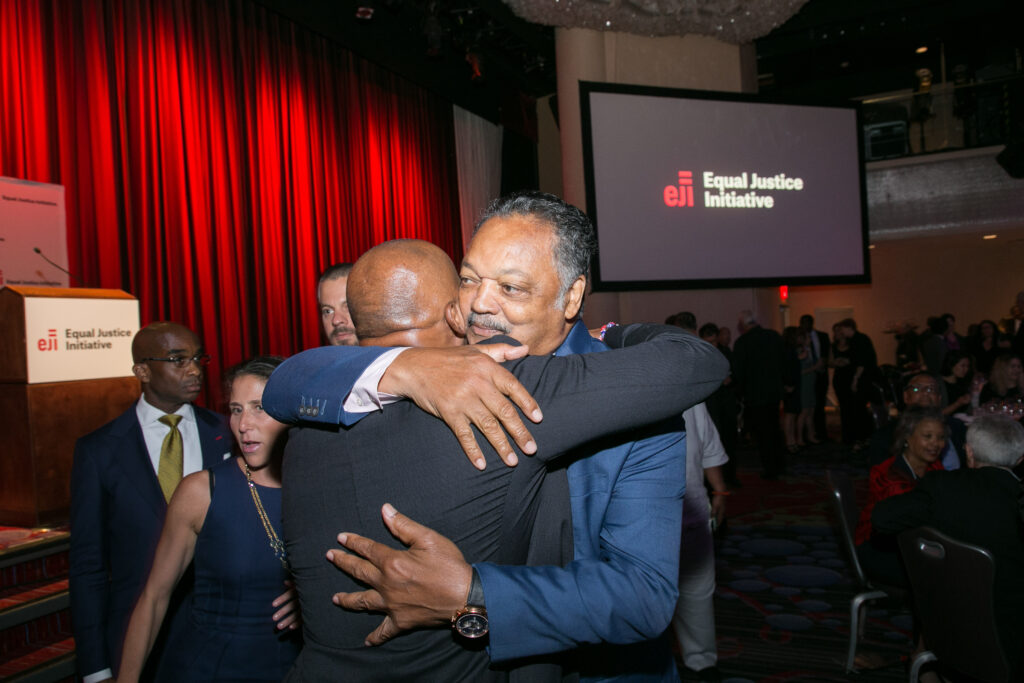
/
EJI Director Bryan Stevenson embraces Rev. Jackson at an EJI event.
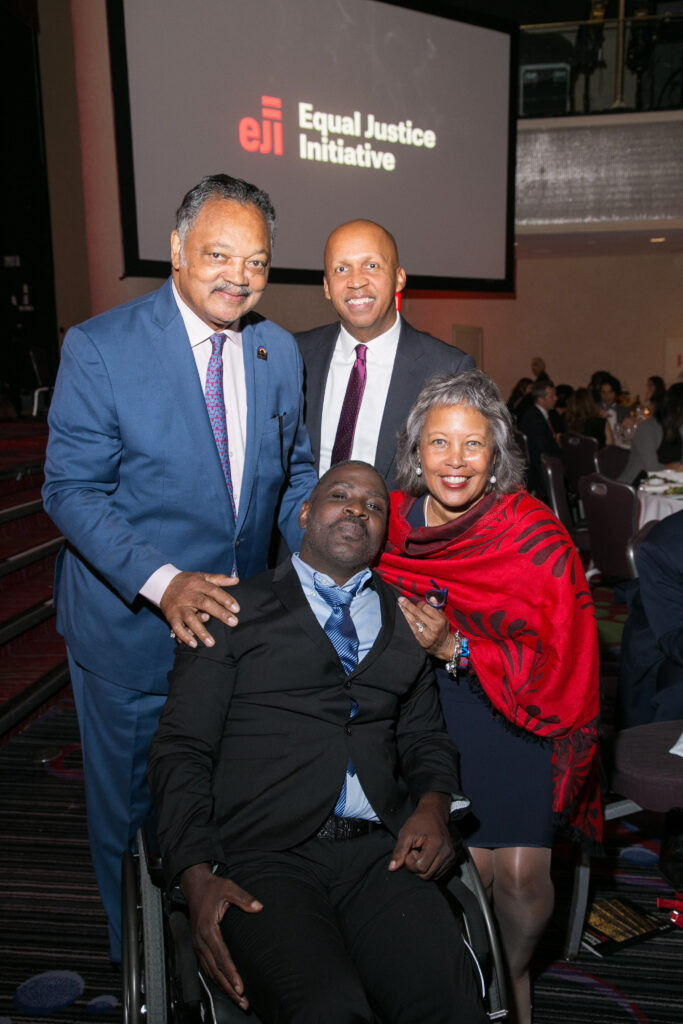
/
Rev. Jackson with Bryan Stevenson, EJI Board Chair Kim Taylor-Thompson, and one of our clients.
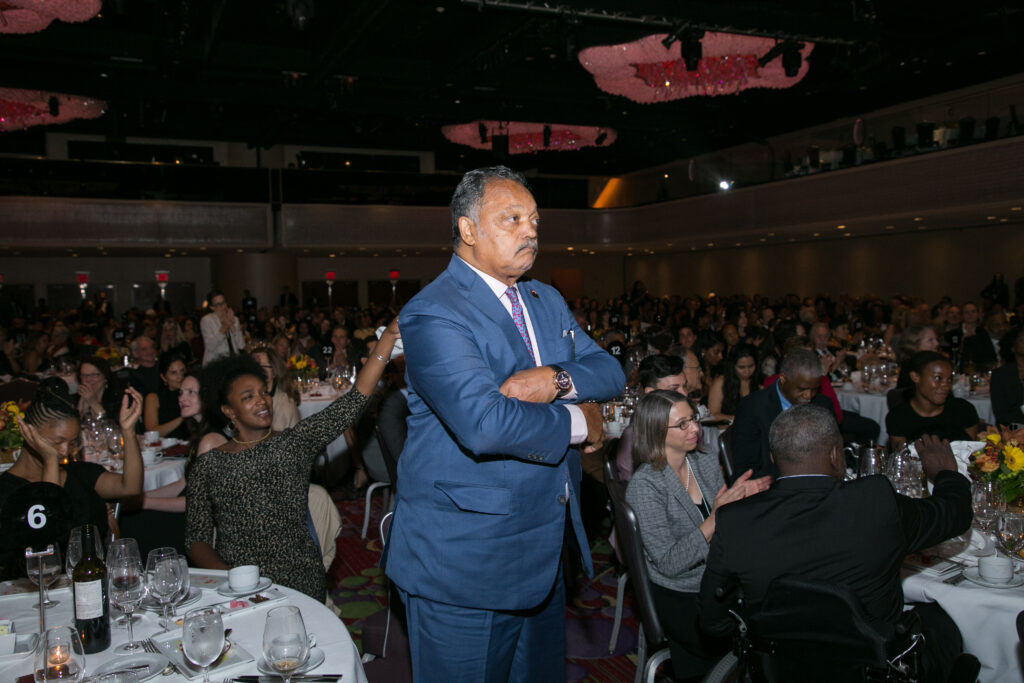
/
Rev. Jackson receives resounding applause at an EJI event.
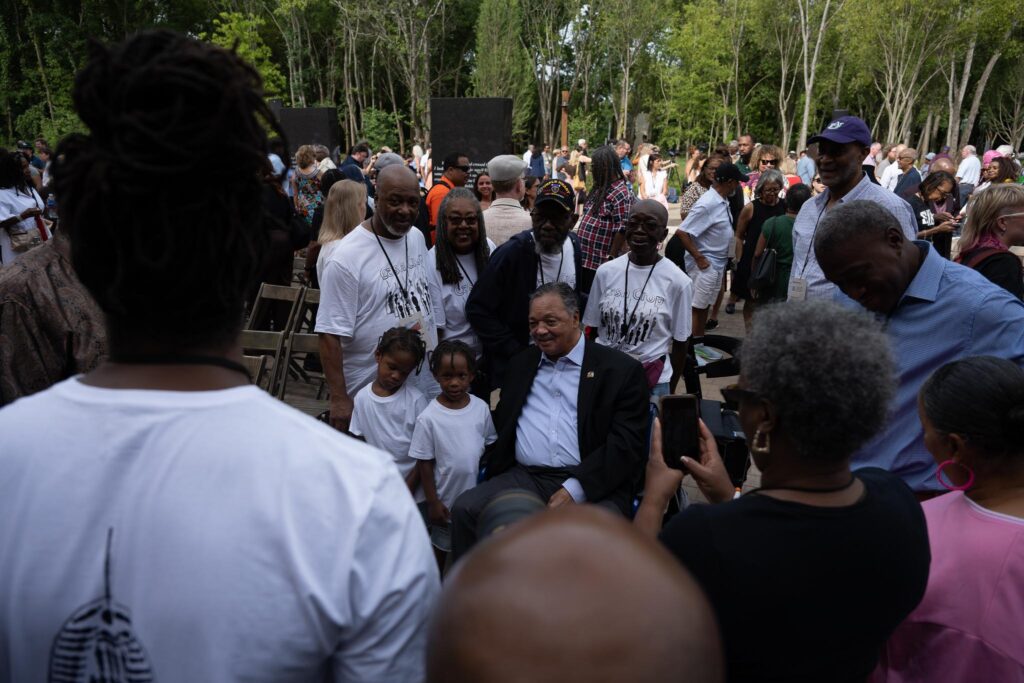
/
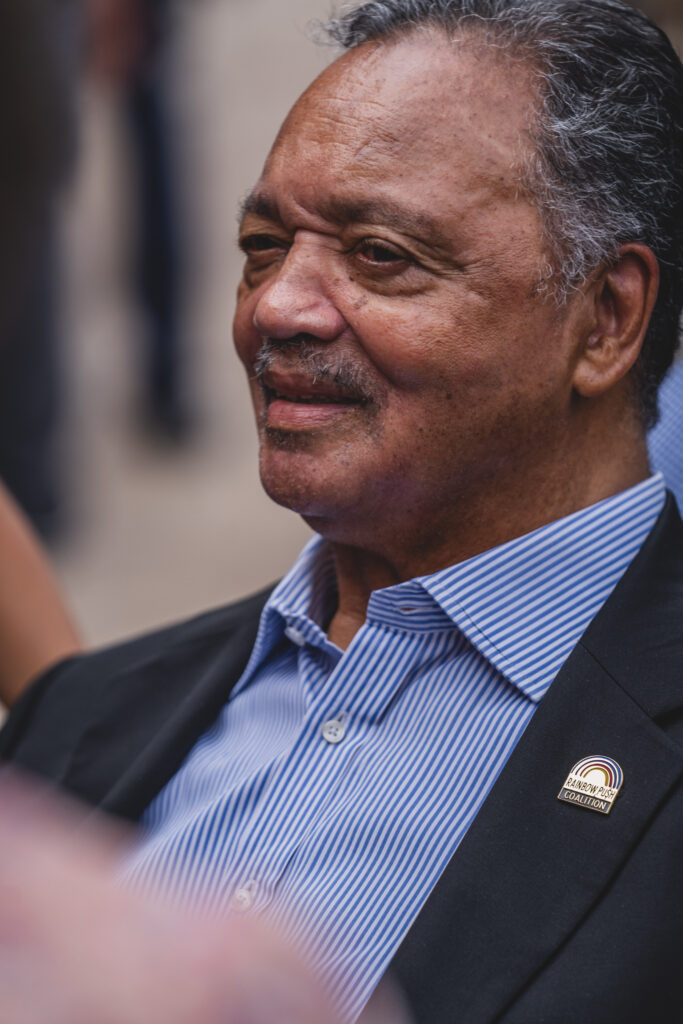
Rev. Jackson attended the dedication of the National Monument to Freedom on Juneteenth 2024.
/
Rev. Jackson at the dedication, 2024.
“We Must Not Surrender Our Spirits”
Rev. Jackson combined his two organizations in 1996 to form the Rainbow/PUSH Coalition, which has paid more than $6 million in college scholarships and helped save the homes of more than 4,000 families facing foreclosures.
In 2000, President Bill Clinton awarded Rev. Jackson the nation’s highest civilian honor, the Presidential Medal of Freedom, for his decades of work to advance civil rights. The president said in awarding the medal:
Dr. King said, “Human progress never rolls on the wheels of inevitability. It comes through the tireless efforts of those willing to be coworkers with God.” The cause of justice has no greater co-worker than Jesse Jackson. It’s hard to imagine how we could have come as far as we have without the creative power, the keen intellect, the loving heart, and the relentless passion of Jesse Louis Jackson.
Rev. Jackson, at 76, announced that he had been diagnosed with Parkinson’s disease in 2017. Last year, it was reported that he was living with progressive supranuclear palsy, which has symptoms that are similar to Parkinson’s. His family did not announce the cause of his death today.
But Rev. Jackson’s activism could not be stopped. He was arrested in Washington in August 2021 while protesting voting restrictions proposed by Republicans, and even after he officially retired as head of the Rainbow PUSH Coalition in 2023, he continued to advocate for social justice. In 2024, he went to Racine, Wisconsin, to encourage young people to vote and in 2025, he joined a boycott of Target after it reversed its diversity initiatives, the Times reports.
Sen. Raphael Warnock, D-Ga., said in a post today that the country “lost one of its great moral voices.”
“With an eloquence and rhythmic rhetoric all his own,” the senator wrote, “Jesse Jackson reminded America that equal justice is not inevitable; it requires vigilance and commitment, and for freedom fighters, sacrifice.”
Rev. Jackson also continued to speak out against the “ethnic nationalism” of the Trump administration.
“The arc of the moral universe is long and it bends towards justice, but you have to pull it to bend. It doesn’t bend automatically,” Rev. Jackson told the Guardian in 2018. “Dr King used to remind us that every time the movement has a tailwind and goes forward, there are headwinds.”
“Those who oppose change in some sense were re-energised by the Trump demagoguery. Dr King would have been disappointed by his victory but he would have been prepared for it psychologically. He would have said: ‘We must not surrender our spirits. We must use this not to surrender but fortify our faith and fight back.’”