At the start of the Civil War, 400,000 Black people were enslaved in Alabama, and the largest number were in Montgomery and surrounding counties. Enslaved Black people made up two-thirds of the population of Montgomery County in 1860. Following the war, Emancipation was poised to create opportunities and growth for everyone in the region. But eventually those who opposed racial equality reclaimed power after the collapse of Reconstruction and they imposed new systems to further the racial subordination and economic exploitation of freed Black people.
Enforced through economic exploitation, convict leasing, lynching, and violence, the racial caste system in Alabama was codified in 1901 when a state constitution was adopted with the stated purpose of “maintain[ing] white supremacy.” Throughout the first half of the 20th century, Black people in Montgomery were subjected to a violent system of racial segregation—frequently abused, beaten, imprisoned, lynched, and killed. This included daily humiliation on city buses.1“The State Campaign Committee,” Montgomery Advertiser, Nov. 3, 1901; Alabama Constitution of 1901, Article VIII, Section 180, Alabama Department of Archives & History.
The activism of people in the Montgomery community following the arrest of Rosa Parks in 1955 shocked the world. Fifty thousand Black people boycotting buses for over a year was an unprecedented act of organized resistance. Committed citizens ultimately succeeded in ending degradation and abuse on buses, one of the primary spaces of racial bigotry.
The courage and commitment of Black people in Montgomery inspired a movement that spread across the country.
A decade later, when thousands of people marched for voting rights from Selma to Montgomery, a new era in America was born. The passage of the Voting Rights Act in 1965 and the end of codified racial segregation that had persisted for over a century lifted this nation closer to its promise of liberty and justice for all.
Some who participated in these historic events are still alive. So too are many who openly opposed this progress or quietly failed to support it. Many more carry living memories of the experiences of their parents and family members during this era.
And all of us—across the country and the world—live in a world shaped by this period of astonishingly effective activism in Montgomery. We are all the heirs of this powerful movement that strengthened this country. We honor all who struggled, suffered, and died for justice in this community. We celebrate those who committed their lives to racial equality decades ago and those who continue to do so today. The battle is not over, and more work remains.
Chapter 1
Why Montgomery?
“Right here in Montgomery, when the history books are written in the future, somebody will have to say, ‘There lived a race of people—a Black people, “fleecy locks and Black complexion,” a people who had the moral courage to stand up for their rights. And thereby they injected a new meaning into the veins of history and of civilization.’”2Martin Luther King Jr., “Montgomery Bus Boycott Speech,” University of Texas at Arlington, accessed Feb. 16, 2026.
Most of the Black people who lived in Montgomery during the civil rights era were descendants of enslaved people who had been trafficked to the region. Their parents, grandparents, and great-grandparents were forced to navigate a world ordered primarily around the institution of slavery, as well as the broader landscape of violence, suffering, and humiliation it wrought.
Rosa Parks was herself the descendant of people enslaved on a plantation in Pine Level, Alabama. After Emancipation, her ancestors continued to live on the same land where they had forcibly labored during the era of slavery. In the post-slavery era, they continued to suffer inhumane treatment by the white plantation owners. A white overseer regularly beat Ms. Parks’s grandfather Sylvester Edwards, starved him, and prevented him from wearing shoes.3Rosa Parks with Jim Haskins, Rosa Parks (Puffin Books, 1992), 14-15.
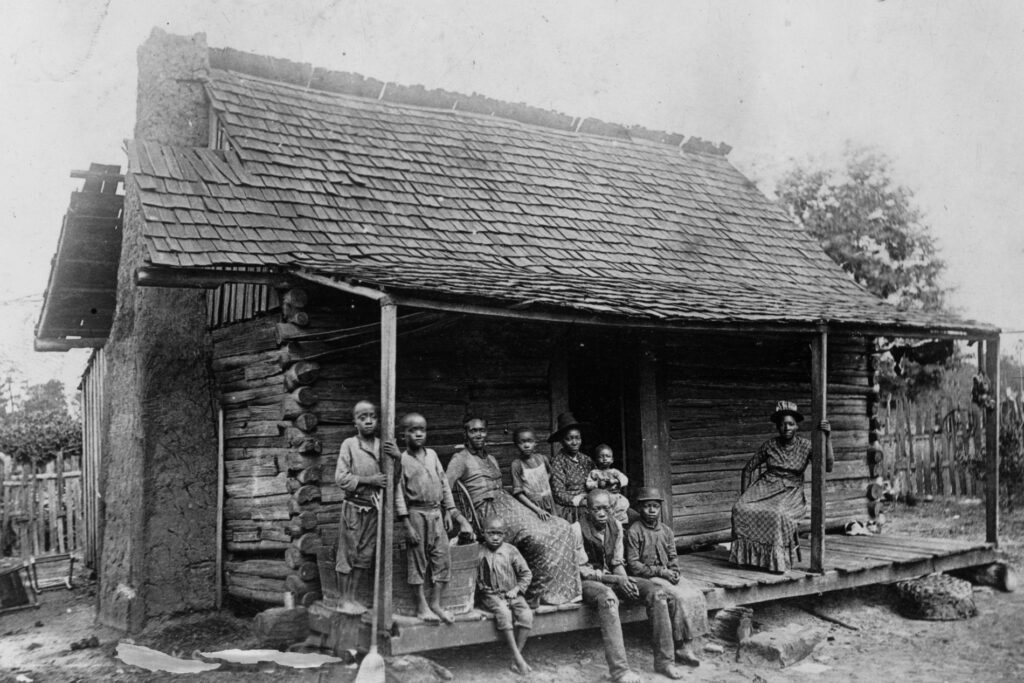
Enslaved family near Eufaula in Barbour County, Alabama.
Library of Congress, Manuscript Division
The injustices inflicted upon him deeply influenced not only on his own life but also that of his descendants. Her grandfather’s perseverance in the face of dehumanization, Ms. Parks wrote, “was passed down almost in our genes.” This lineage is one of the many ways in which the activism of Montgomery was shaped by the history of racial injustice in Alabama.4Parks and Haskins, Rosa Parks, 15.
“The Scar of Racial Hatred”
The history of racial injustice in Montgomery began long before people of African descent were enslaved and trafficked to the region. As the Rev. Dr. Martin Luther King Jr. wrote,
Our nation was born in genocide when it embraced the doctrine that the original American, the Indian, was an inferior race. Even before there were large numbers of Negroes on our shores, the scar of racial hatred had already disfigured colonial society. From the sixteenth century forward, blood flowed in battles over racial supremacy.5Martin Luther King Jr., Why We Can’t Wait (Signet Books, 1964), 120.
Humans have lived in the territory that now comprises the state of Alabama for at least 13,000 years. Stone tools used by Indigenous people more than 11,000 years ago have been found in present-day Montgomery County. Modern Indigenous nations formed between the 1500s and 1700s, and the Muscogee people—referred to as “Creeks” by Europeans—occupied large swaths of the territory now known as Alabama.6Dennis Pillion, “The First Alabamians Arrived 13,000 Years Ago, Long Before Moundville,” AL.com, Dec. 20, 2021; David M. Johnson Jr., Handbook of Alabama’s Prehistoric Indians and Artifacts, 2nd ed. (Borgo Publishing, 2017), 93; Neal Salisbury, “The Indians’ Old World,” William & Mary Quarterly 53, no. 3 (July 1996): 450-51; Ned J. Jenkins, “Tracing the Origins of the Early Creeks, 1050-1700 CE,” in Mapping the Mississippian Shatter Zone, ed. Robbie Ethridge and Sheri M. Shuck-Hall (University of Nebraska Press, 2009), 188; Joshua Piker, “Colonists and Creeks,” Journal of Southern History 70, no. 3 (2004): 503.
The Muscogee Nation encompassed many socially and politically diverse peoples with their own languages, geographic origins, and creation stories. One of these groups, the Alabama-Coushatta, coalesced around the fertile and strategic junction near present-day Montgomery where the upper Alabama River meets the Coosa and Tallapoosa rivers.7Steven C. Hahn, The Invention of Creek Nation, 1670-1763 (The University of Nebraska Press, 2004), 242; Bill Grantham, Creation Myths and Legends of the Creek Indians (University Press of Florida, 2002), 12; Sheri M. Shuck-Hall, “Alabama-Coushattas in Alabama,” Encyclopedia of Alabama, updated Aug. 8, 2025.
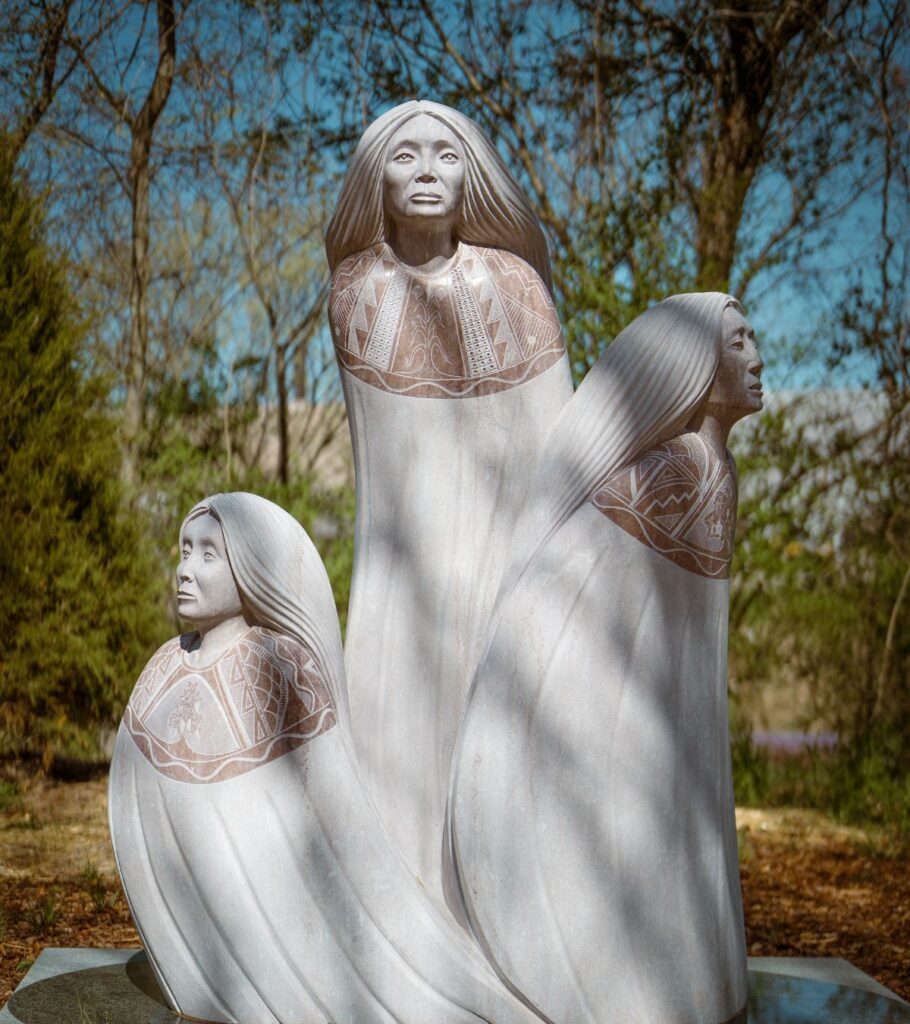
Three Sisters of the Earth by Cliff Fragua at Freedom Monument Sculpture Park in Montgomery, Alabama.
Human Pictures
The first contact between Europeans and Indigenous Peoples living in Alabama occurred in the mid-16th century during a Spanish expedition led by Hernando de Soto. The territory became a site of conflict between Europeans and Indigenous Peoples, as well as between competing European powers who claimed the territory for their own. This led to centuries of war, disease, and dispossession of Indigenous land.8Shuck-Hall, “Alabama-Coushattas in Alabama.”
This dispossession accelerated when the U.S. government took control of great swaths of territory to the south of the original 13 colonies and began to subsidize white settlement in the region. To facilitate this, it carried out a policy of forced removal of Indigenous Peoples from their ancestral homelands. By 1838, over 20,000 Muscogee people had been forcibly removed or fled as the U.S. government seized over 20 million acres of their land, much of which was awarded to white Americans.9Equal Justice Initiative, Slavery in America (2018); Christopher D. Haveman, “The Removal of the Creek Indians from the Southeast, 1825-1838,” PhD diss. (Auburn University, 2009), 354; “Muscogee (Creek) Removal,” National Parks Service, accessed Dec. 15, 2025.
Muscogee people who were captured while resisting removal in the 1830s were held in the Montgomery County jail.11Haveman, “The Removal of the Creek Indians,” 247.
In 1836, more than 2,300 Muscogee men, women, and children were loaded onto steamboats in Montgomery and removed by boat and then forced to march hundreds of miles by foot on the “Trail of Tears.” Hundreds perished or went missing on this journey. Later that year, President Andrew Jackson ordered the forced removal of all remaining Muscogee people from their ancestral homelands.12Haveman, “The Removal of the Creek Indians,” 2, 254, 258, 267, 269.
This history is still not often acknowledged. “We are perhaps the only nation which tried as a matter of national policy to wipe out its Indigenous population,” Dr. King wrote. “Moreover, we elevated that tragic experience into a noble crusade. Indeed, even today we have not permitted ourselves to reject or feel remorse for this shameful episode.”13King, Why We Can’t Wait, 120.
A Capital of Domestic Trafficking
Prior to the late 18th century, few people of African descent lived in the area now known as Alabama. That changed in the 1780s when the U.S. government began encouraging white settlers eager for cheap, fertile land to move to this area from states in the Upper South, including North Carolina, Tennessee, Virginia, and Kentucky. These settlers trafficked enslaved Black people to work the land and care for their homes.14Anthony Gene Carey, Sold Down the River (University of Alabama Press, 2011), 21; Equal Justice Initiative, Slavery in America.
This dynamic coincided with the invention of the cotton gin, which radically transformed the speed and profitability of cotton production and created incentives for white settlers in search of wealth to expand their plantations and enslave more people.
In territories that would later become the Lower South states of Alabama, Louisiana, Mississippi, and Florida, the demand for enslaved Black people skyrocketed. In 1808, Congress outlawed transatlantic trafficking of enslaved people. As a result, white settlers turned to domestic trafficking to meet this new demand.15Adam Rothman, “The Domestication of the Slave Trade in the United States,” in The Chattel Principle: Internal Slave Trades in the Americas, ed. Walter Johnson (Yale University Press, 2005), 33; Frederic Bancroft, Slave Trading in the Old South (Frederick Ungar Publishing Co., 1959), 8-11.
The new, burgeoning domestic trafficking industry forced hundreds of thousands of people into bondage in the Deep South, through reproduction which was often forced, and human trafficking of enslaved people laboring in the Upper South, where many had developed deep family connections over generations.
An elaborate trafficking network emerged to provide Alabama farmers with a new and highly profitable supply of enslaved workers.16Rothman, “The Domestication of the Slave Trade,” 39-40.
An estimated one million enslaved people were forcibly transferred from the Upper South to the Lower South between 1790 and 1860. Over half were separated from a spouse or a child.17David L. Lightner, Slavery and the Commerce Power (Yale University Press, 2006), 6; Steven Deyle, “The Domestic Slave Trade in America,” in The Chattel Principle, 93; Carey, Sold Down the River, 51; Equal Justice Initiative, “Black Families Severed by Slavery,” Jan. 29, 2018.
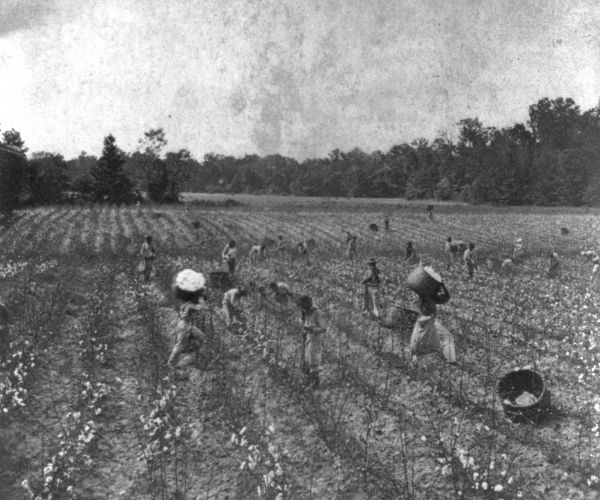
By 1860, more than 400,000 Black people were enslaved in Alabama.18U.S. Census Bureau, “State of Alabama,” 1860 U.S. Census, 7.
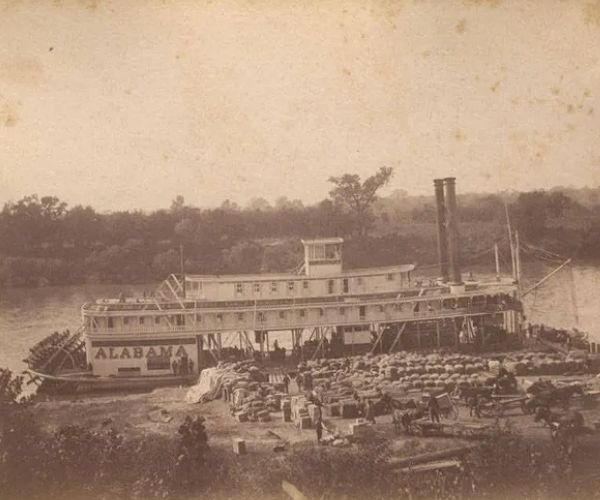
Loading cotton on the steamboat Alabama on the Alabama River in Montgomery.
Alabama Department Of Archives And History
Enslaved people work in cotton fields outside Montgomery in the 1860s.
Library of Congress
Montgomery developed as a hub in the domestic trafficking network as new methods of transportation altered the routes used by those seeking enslaved labor. The arrival of the steamboat in 1811 allowed traffickers to transport enslaved people via inland rivers, including the Ohio, Mississippi, and Alabama. The steam locomotive arrived in the 1830s, and within two decades, rail lines stretched across the South. Often cleared, constructed, and maintained by enslaved people laboring in dangerous and frequently deadly conditions, these rail lines became a preferred method for trafficking enslaved people to the Lower South. Trips that had taken weeks on foot now took less than two days by rail.19Lightner, Slavery and the Commerce Power, 10; Theodore Kornweibel Jr., Railroads in the African American Experience (Johns Hopkins University Press, 2010), 11, 25, 28.
These transportation changes transformed Montgomery from one of many stops along the overland route to a primary trafficking market. In 1847, a direct steamboat line was established between New Orleans and Montgomery, which eventually rivaled Mobile, Alabama, as a center for trading in enslaved Black people.20J. Mills Thornton, Politics and Power in a Slave Society (Louisiana State University Press, 1978), 275.
Montgomery’s proximity to the fertile Black Belt region, where enslavers amassed large enslaved populations to work the dark, rich soil, elevated Montgomery’s prominence in human trafficking. The enslaved Black population in Montgomery County rose from 2,655 in 1820 to 23,710 in 1860.21Equal Justice Initiative, Slavery in America.
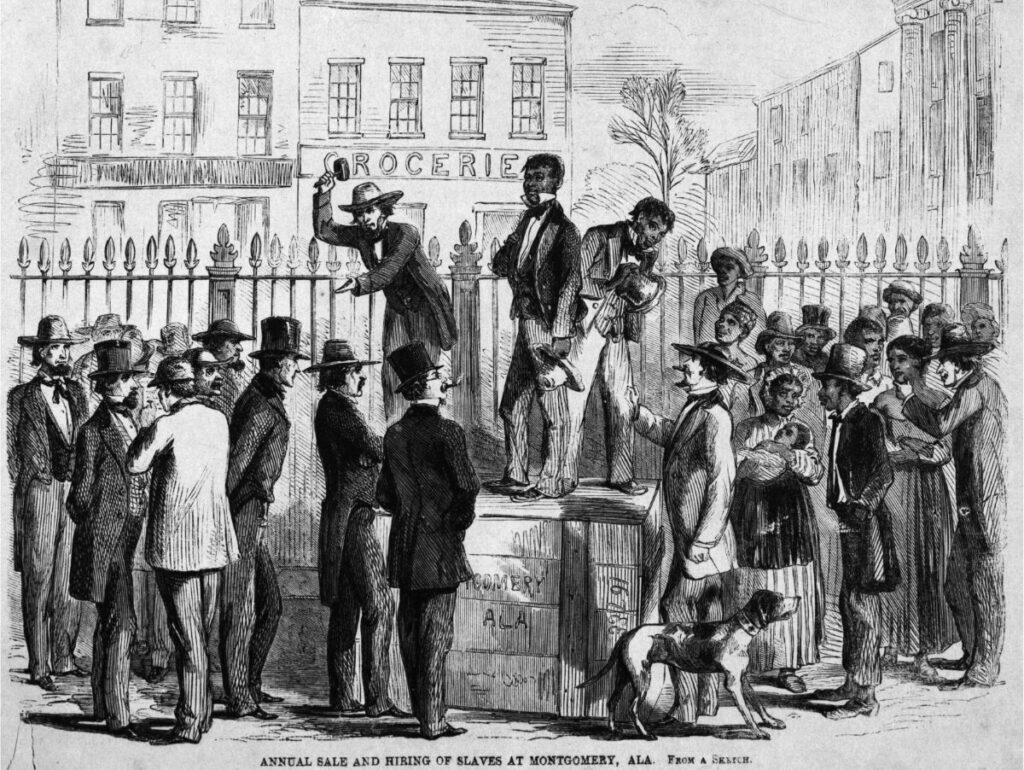
By 1860, Montgomery was the capital of the domestic trafficking of enslaved people in Alabama, a state with one of the largest enslaved populations in the country. More people were enslaved in and around Montgomery than any other Alabama city.22U.S. Census Bureau, “Census of Population & Housing, 1860,” 1860 U.S. Census; U.S. Census Bureau, “State of Alabama,” 8; Equal Justice Initiative, Slavery in America.
Illustration of an auction in Montgomery published in 1861.
Donated by Corbis
The overwhelming presence of Black people in the Montgomery community would have a lasting impact on the history of the city. In fact, many people who later participated in the Montgomery Bus Boycott were descended from people trafficked to and enslaved in Montgomery County.
Reconstruction’s Collapse
On February 18, 1861, Jefferson Davis was sworn in as president of the Confederacy in Montgomery, the first capital of the Confederate States of America. In an address to the Confederate Congress in Montgomery on April 29, 1861, Davis declared white people a “superior race,” claimed that slavery was ”indispensable,” and said the Southern states were driven to secede because their “interests of such overwhelming magnitude” in the institution of slavery had become “imperiled.”23Jefferson Davis, “First Inaugural Address,” Feb. 18, 1861, The Papers of Jefferson Davis, Rice University; Jefferson Davis, “Message to Congress,” April 29, 1861, Yale Law School Lillian Goldman Law Library.
After Emancipation and the Confederacy’s defeat in the Civil War, federal troops arrived in Alabama during the era of Reconstruction, the period of social, political, and economic re-creation that promised equality for the beleaguered nation. The adoption of the Fourteenth Amendment in 1868 extended equal protection of the law to Black people, and the Fifteenth Amendment, passed in 1870, gave African American men the right to vote nationwide.24Michael W. Fitzgerald, “Reconstruction in Alabama,” Encyclopedia of Alabama, updated Aug. 18, 2025; National Archives, “14th Amendment to the U.S. Constitution: Civil Rights (1868),” accessed Feb. 24, 2026; National Archives, “15th Amendment to the U.S. Constitution: Voting Rights (1870),” accessed Feb. 24, 2026.
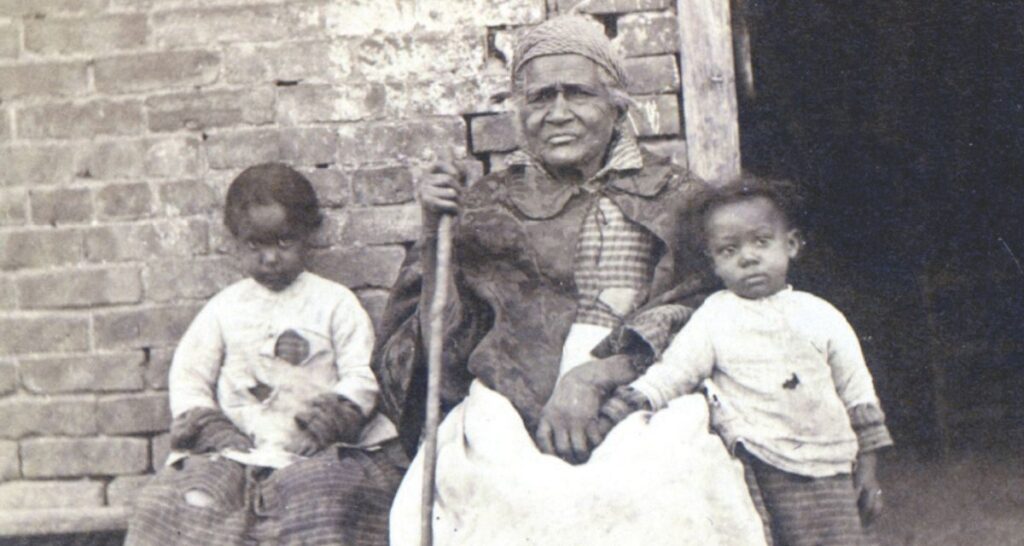
Betty Jackson, a woman once enslaved by President Andrew Jackson, sits with her great-grandchildren, 1867.
The promise of Reconstruction greatly shaped Montgomery, leading to the founding of institutions that would become vital in the civil rights era.
The Lincoln Normal School, established in Marion, Alabama, in 1867, moved to Montgomery and became the country’s first state-sponsored higher education institution for Black people. Later renamed as Alabama State College—and today known as Alabama State University—it was “the social and cultural heartbeat” of the Black community in Montgomery in the mid-20th century.25F. Erik Brooks, “Alabama State University,” Encyclopedia of Alabama, updated May 9, 2024; Vanzetta Penn McPherson, interview, Montgomery Memory Project, Equal Justice Initiative, Nov. 24, 2025.
Many participants in the Montgomery Bus Boycott were connected to Alabama State, and its faculty and students served as leaders in the civil rights movement throughout the 1950s and ’60s. At the same time, many white Montgomerians regarded Alabama State as a threat to racial hierarchy in the city, and when higher education was ordered to desegregate in Alabama in the 1960s, state leaders created a new public university in the city, Auburn University at Montgomery, rather than increase funding to Alabama State, which was then Montgomery’s only public college.26Rebecca Retzlaff, Planning White Supremacy (University of Alabama Press, 2026), 46; Fred D. Gray, Bus Ride to Justice (Black Belt Press, 1995), 269-272.
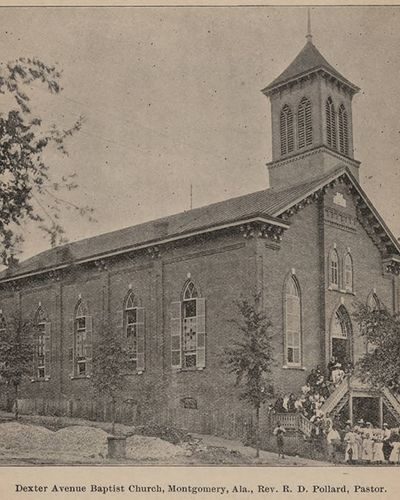
Dexter Avenue Baptist Church in Montgomery c. 1895
Alabama Department of Archives and History
Dexter Avenue Baptist Church, where the Rev. Dr. Martin Luther King Jr. pastored and led many mass meetings during the Boycott, was founded in 1877 at the end of the Reconstruction era. It sits on the site of a “pen” that had been used in the trafficking of enslaved people and just one block from the Alabama State Capitol.27Dexter Avenue King Memorial Baptist Church, “History,” accessed Feb. 6, 2026.
In the 1870s, a new business class composed of formerly enslaved people emerged in Montgomery, many of whom served exclusively a Black clientele. In the years after Emancipation, Montgomery also became home to many rural transplants seeking to escape sharecropping and tenant farming.28Eric Foner, Reconstruction(Harper & Row, 1988), 397; Retzlaff, Planning White Supremacy, 3, 14-15.
Many white Southerners remained fiercely resistant to racial equality. In the immediate aftermath of Emancipation, widespread violence directed at newly freed Black people led to dangerous and lawless conditions in the region. In many cases, the new constitutional rights of Black people were ignored.
The Reconstruction government collapsed in Alabama by the end of the 1870s and the federal government ceased its military protection of formerly enslaved Black people. The legal regime of Jim Crow segregation emerged and was violently enforced for decades.29Fitzgerald, “Reconstruction in Alabama.”
The Era of Racial Terror
Lynching became the most public and notorious form of racial terrorism employed to maintain the social, political, and economic subordination of Black people.
Montgomery County’s first documented racial terror lynching took place in 1890, when a Black man from Birmingham named Ike Cook—who had been accused of stealing a pair of pants—was ambushed on a roadside 12 miles from Montgomery and shot to death by a white mob.30“Gone to a Higher Tribunal,” Birmingham News, Aug. 14, 1890; “Shot From Ambush,” Tennessean (Nashville), Aug. 12, 1890.
At least a dozen documented lynchings of Black people took place in Montgomery County between 1890 and 1934. None of the perpetrators were ever held accountable.
As late as 1934, a mob of white men beat and shot to death a 16-year-old Black boy named Otis Parham. For most Black Montgomery residents who would go on to lead or participate in the Montgomery Bus Boycott, the era of racial terror lynching was within living memory and had profoundly shaped their lives. This level of violence, perpetrated with impunity, precluded mass organizing as a viable option in Montgomery prior to the 1950s.31“Paroled Convict, Negro Youth Are Killed,” Tennessean (Nashville), June 19, 1934.
Racial terrorism also defined and altered the racial demographics of the city. Montgomery had been a majority-Black city in the aftermath of the Civil War, and Black people still made up 57% of the city’s residents at the start of the 20th century.
But as large numbers of African Americans fled to the North and West to escape racial terrorism in the first half of the 1900s, the Black population in Montgomery, like many other Southern cities and towns, precipitously declined. By 1955, at the beginning of the Montgomery Bus Boycott, Black people made up less than 40% of the city’s population. Montgomery’s shift to a white majority facilitated the ascendancy of white economic and social power in the city.32Retzlaff, Planning White Supremacy, 46-47.
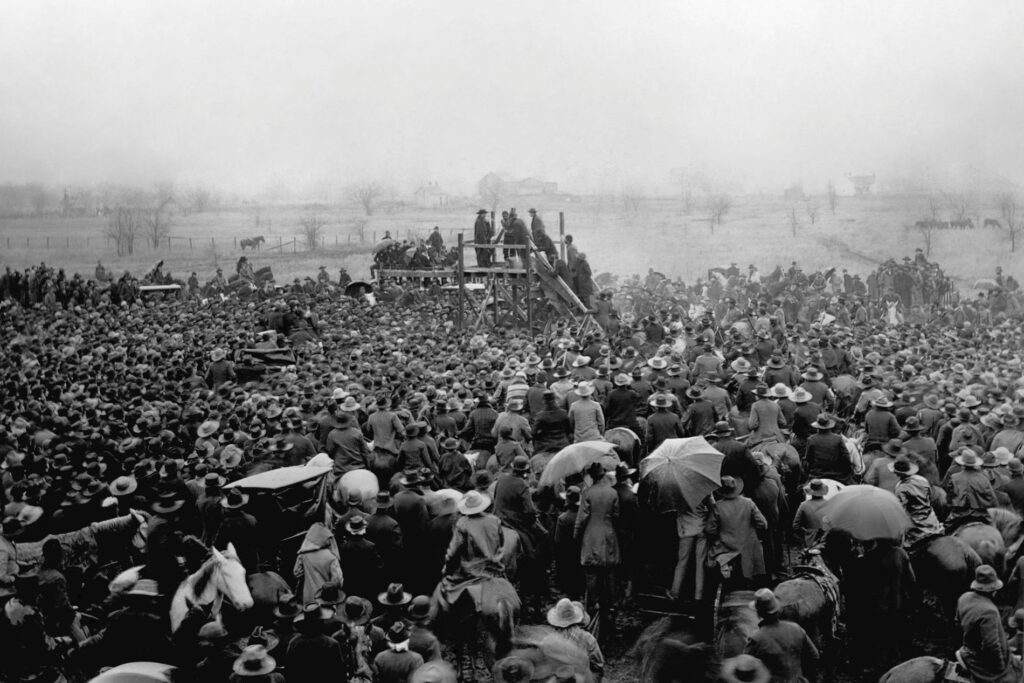
Lynching of Henry Smith in Paris, Texas, on February 1, 1893.
Library of Congress via Getty Images
Jim Crow in Montgomery
The system of segregation, of which the bus system was a part, was codified with Alabama’s adoption in 1901 of a new state constitution that white leaders explicitly proclaimed was designed to enshrine “white supremacy.”33“The State Campaign Committee,” Montgomery Advertiser, Nov. 3, 1901.
State lawmakers created one of the most rigid and extensive systems of racial segregation in the world—prohibiting marriage between white and Black people, mandating separate schools for Black and white children, disenfranchising most Black men, and creating a legal system of second-class citizenship for Black people that would last for generations.34Equal Justice Initiative, Slavery in America.
No area of daily life was too trivial to regulate—the law even barred Black and white people from playing checkers together.
The Montgomery City Code enforced the separation of races across virtually all daily activities, including recreation, dining, and public transportation.
Within city limits, Black and white people were forbidden from playing cards, dice, dominoes, checkers, or billiards together. Any owner or proprietor of facilities including theaters, auditoriums, parks, and vaguely defined “room[s]” and “hall[s]” that did not completely segregate entrances, exits, and standing and seated accommodations could face legal consequences. Ticket sales and lines for admittance had to be completely separate unless “well defined physical barriers” achieved adequate racial segregation.35Montgomery, Ala., City Code, ch. 20 § 28, ch. 25 § 5, ch. 34 § 5 (1952).
As one of the few places where Black and white people “were segregated under the same roof and in full view of each other,” city buses served as the stages for a daily ritual of racial humiliation and abuse.36Aldon D. Morris, The Origins of the Civil Rights Movement (The Free Press, 1984), 17.
Drivers, all of whom were white men, were charged with maintaining racial segregation on the buses and were specifically granted police powers in order to do so. The only exception to this otherwise strictly enforced racial boundary was for “negro nurses having in charge white children or sick or infirm white persons.”37Montgomery, Ala., City Code, ch. 6 § 10, ch. 6, § 11 (1952); Gray, Bus Ride to Justice, 6.
The strictures of the Jim Crow era meant that Black residents of Montgomery moved in separate—and unequal—spaces from white people. Black children in Montgomery were relegated to underfunded schools, Black families were confined to less desirable neighborhoods, and Black people were banned from white recreational facilities and other establishments.
But, because there were no separate public buses for Black and white people, using racially segregated public buses was unavoidable and became the primary space of racial humiliation for Black Montgomerians.
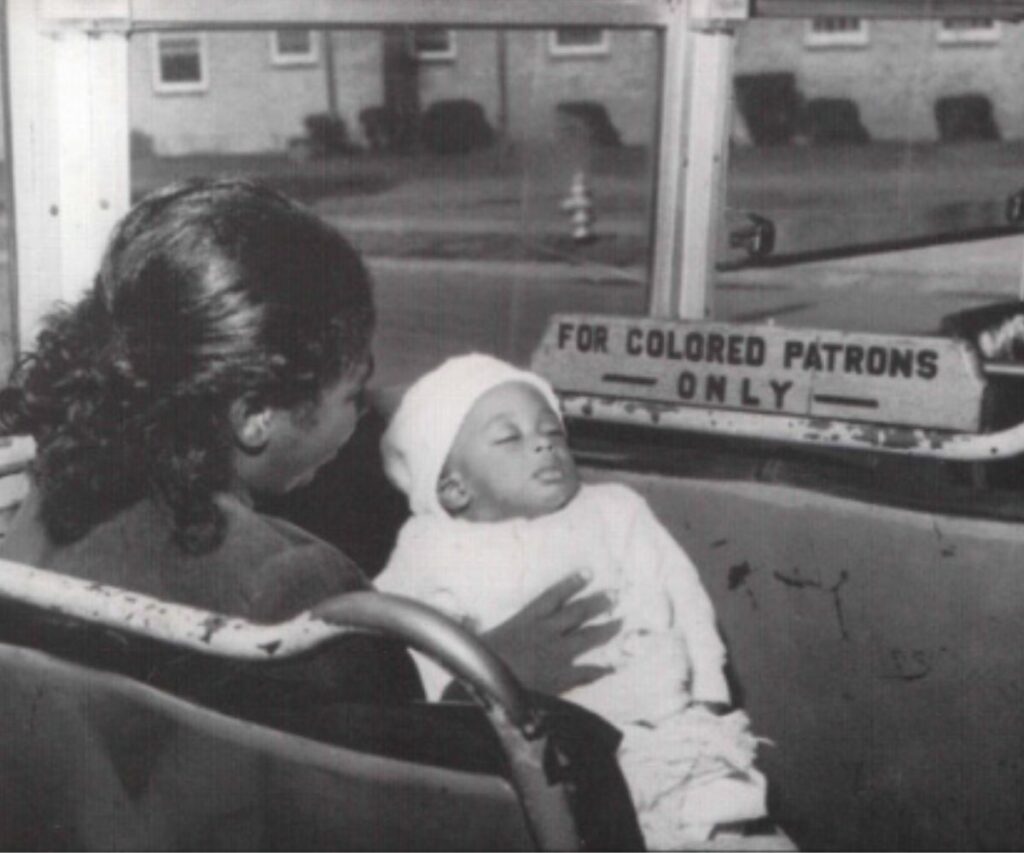
A mother and her child sit on a segregated bus in 1955.
Courtesy of the Jim Crow Museum and Ferris State University
Virtually every Black resident directly experienced mistreatment at the hands of white bus drivers and white passengers. This unrelenting humiliation fueled one of the most prominent mass protests in U.S. history, the Montgomery Bus Boycott.
Jo Ann Robinson, leader of the Women’s Political Council (WPC), a politically oriented civil rights group focused on Black voter engagement and anti-discrimination efforts, wrote that civil rights efforts in Montgomery began immediately after the legal codification of the system of segregation. “[F]rom the beginning, protests had been registered repeatedly,” she wrote. Black people “were determined to get an education, to become financially secure, so that when the time came they would be prepared to walk away from the system.”38Jo Ann Gibson Robinson, The Montgomery Bus Boycott and the Women Who Started It, ed. David J. Garrow (University of Tennessee Press, 1987), 8.
Similarly, Dr. King traced the roots of the activism in Montgomery to the service of Black veterans in World War I and II and the Great Migration, during which millions of Black Americans fled the racial terror of the South to the North and West, as well as to the opportunities for economic and educational advancement created by Black civic and labor organizations in the first half of the 20th century.
These events built a platform upon which Black people could organize and insist that they comprised “an equal element in a larger social compound and accordingly should be given rights and privileges.”39Martin Luther King Jr., Stride Toward Freedom (Harper & Row, 1958), 189-90.
This activism took inspiration from anti-colonial movements that developed in India and Africa and spread across the globe after World War II. “The determination of Negro Americans to win freedom from all forms of oppression,” Dr. King wrote, “springs from the same deep longing that motivates oppressed peoples all over the world.”40King, Stride Toward Freedom, 191.
This report was written, researched, and produced by the Equal Justice Initiative in Montgomery, Alabama. EJI researchers, legal staff, and program staff spent hundreds of hours researching, writing, and gathering and reviewing source material for the preparation of this report. A special thanks is owed to Sia Sanneh, Jacob Hoerger, Sachi Shepherd, and Ben Maxymuk for their research and writing. Aaryn Urell, Randy Susskind, Jamie Fass, and Danielle Carrasquero played an essential role in formatting, layout, photo research, and editing.
We are grateful to share this report and information with all of you. Please visit EJI’s Legacy Sites and Montgomery Square to experience the full power of this report and content.
Bryan Stevenson, Executive Director
How to cite
Equal Justice Initiative, "The Montgomery Decade That Changed the World: 1955 to 1965" (2026).
Text copied
Sidebar
The 1900-1902 Montgomery Streetcar Boycott
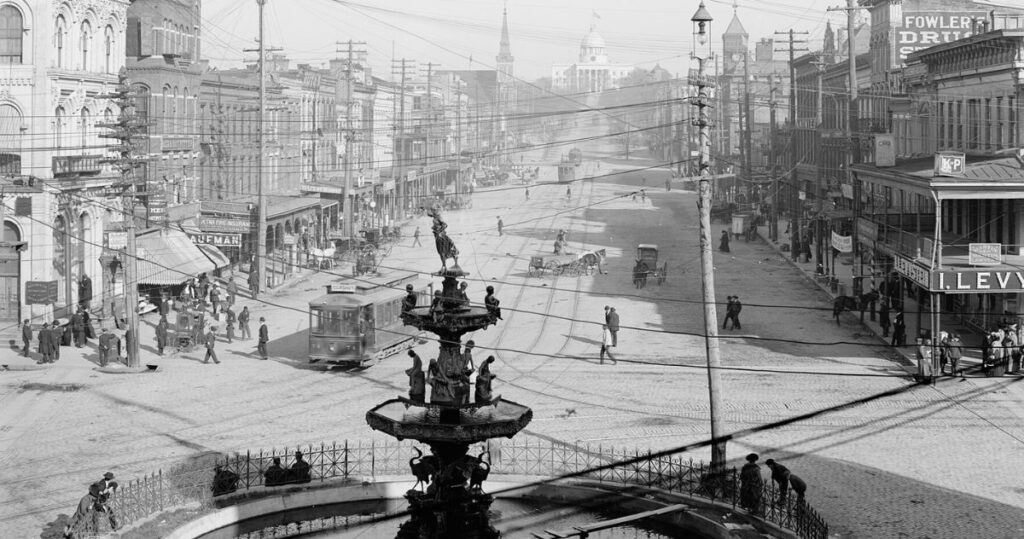
A streetcar in Court Square in Montgomery, 1906.
Wikimedia Commons
Decades before the Montgomery Bus Boycott, Black residents in Montgomery organized to protest the city’s first segregated transit ordinance. Similar protests took place in more than 25 other Southern cities at the start of the 20th century. These movements arose in response to the passage of streetcar segregation laws and ordinances at the end of the 19th century that, while initially limited to certain counties and cities, were eventually enforced statewide in Alabama and nine other Southern states.41August Meier and Elliot Rudwick, “The Boycott Movement Against Jim Crow Streetcars in the South, 1900-1906,” The Journal of American History 55, no. 4 (March 1969): 756-57. According to Meier and Rudwick, Louisiana, Mississippi, Virginia, Tennessee, Florida, Texas, Oklahoma, and North Carolina passed statewide transportation segregation legislation in the first decade of the twentieth century, while in South Carolina and Alabama, city ordinances and streetcar company regulations similarly made segregation the enforced norm.
An electric streetcar system—the first in the U.S.—was established in Montgomery in 1886. On August 6, 1900, after a campaign by the local white press, the Montgomery City Council unanimously passed an ordinance that required separate accommodations for Black and white passengers on streetcars.42Scotty Kirkland, “Retrospect: The Lightning Route,” Business Alabama, Sept. 24, 2024; “Will Separate Races on Cars,” Montgomery Advertiser, Aug. 7, 1900.
The ordinance mandated that streetcar employees separate passengers by race, with limited exceptions, and gave conductors and other employees police authority to enforce its provisions.
Passengers who refused to comply could be fined up to $100 and employees who failed to enforce the ordinance were likewise subject to hefty fines.43“Will Separate Races on Cars.”
To comply with the law’s segregation requirements, Montgomery’s streetcar company designated seats in the front of the cars for white passengers and forced Black passengers to sit in the back.44“Montgomery Negroes Boycott Street Cars,” Atlanta Constitution, Aug. 16, 1900.
In Southern cities, segregated seating served as a physical representation of racial subordination, serving not only to separate Black passengers from white ones, but to transform everyday transit into a site of humiliation and control.45Blair L.M. Kelley, Right to Ride (University of North Carolina Press, 2010), 87.
The mobilization of Montgomery’s Black residents in response to the law was swift. Catalyzed in large part by preachers who encouraged their congregations to walk where possible, and supported by Black “hackmen and draymen”—private horsecart drivers who transported passengers and goods—this collective resistance quickly and significantly reduced the city’s Black streetcar ridership and put financial pressure on the streetcar company.46“Cars Not Boycotted,” Montgomery Advertiser, Aug. 16, 1900; Meier and Rudwick, “The Boycott Movement,” 764; “Montgomery Negroes Boycott Street Cars;” “Streetcar Receipts Fall Off,” Sept. 20, 1900.
The boycott, which lasted from 1900 to 1902, was unprecedented in its length and scope, and achieved a significant but temporary victory. In 1902, the city’s streetcar company suspended enforcement of the ordinance. Four years later, a new ordinance reinstituted segregated accommodations.47Meier and Rudwick, “The Boycott Movement,” 763, 774-75; “Streetcar Receipts Fall Off;” “For Separate Cars,” Montgomery Advertiser, Oct. 18, 1906.
The streetcar system in Montgomery was ended soon after a public bus service was established in the city in 1935.48Kirkland, “Retrospect.”
The mobilization and activism of Montgomery’s Black residents during the streetcar boycott laid important groundwork for the historic Montgomery Bus Boycott.