Sidebar
The Global Impact of the Montgomery Decade
The Montgomery Bus Boycott, the integration efforts that followed, and the Selma to Montgomery March resulting in the Voting Rights Act of 1965 inspired communities across the globe to engage in boycotts, sit-ins, and marches for civil rights and liberation.
The Bus Boycott reverberated globally soon after it began. Three months into the protest, journalists from India—where Dr. King would travel in 1959 to deepen his engagement with Mahatma Gandhi’s principles of nonviolence—France, and England traveled to Montgomery to cover Dr. King’s trial for allegedly organizing an illegal boycott. The power of economic boycotts and collective, nonviolent action reached people around the globe and inspired similar acts of civil disobedience to advance racial justice.1 King, Stride Toward Freedom, 147; “India Trip,” Martin Luther King, Jr. Research and Education Institute, accessed Feb. 14, 2026.
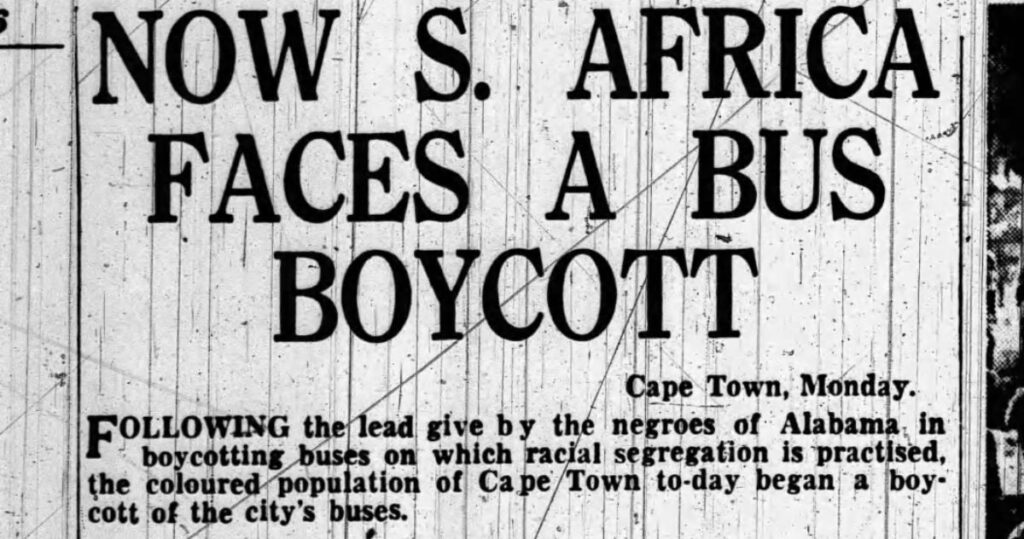
Thousands of Black people boycotted segregated buses in Cape Town, South Africa, in April 1956. The apartheid system of strict racial segregation dictated nearly every aspect of life for Black South Africans. In Cape Town, Black passengers were forced to ride on the upper deck of double-decker buses while the lower deck was reserved for white passengers. Black South Africans protested, “Keep Your City Clean—Away With Bus Apartheid” and refused to ride for a month.2 “Now S. Africa Faces a Bus Boycott,” Bolton News (Greater Manchester), April 16, 1956; “Black Citizens Boycott Buses in Capetown, South Africa,” Martin Luther King, Jr. Research and Education Institute, accessed Dec. 24, 2025; “Capetown Negroes Boycott Bus Lines,” New York Times, April 17, 1956; G.H. Pirie, “Implanting Racial Ideology: Bus Apartheid in Cape Town,” Social Dynamics 15, no. 1 (1989), 67.
The following year, a fare increase caused Black residents of Alexandra to launch a bus boycott in Johannesburg, South Africa. The township of Alexandra is a sprawling Black neighborhood located next to Sandton, one of the wealthiest areas in South Africa. For Alexandra residents, the fare increase was oppressive—80% of Black Africans in Johannesburg were living in poverty. The protest soon spread to surrounding towns.3 “South Africans Successfully Boycott Buses in Johannesburg, 1957,” Global Nonviolent Action Database, Swarthmore College, updated Sept. 30, 2012.
Similar to the bus conditions in Montgomery before 1956, Johannesburg buses were overcrowded, routes and schedules failed to meet riders’ needs, and drivers routinely disrespected bus riders. Chanting “Azikwelwa,” or “We will not ride,” the protesters in 1956 were successful in pressuring bus operators to rollback the fare to its previous rate. Formed in 1959, South Africa’s Pan-Africanist Congress utilized boycotts, marches, and civil disobedience to challenge and ultimately dismantle the country’s system of racial apartheid.4 Pamela E. Brooks, Boycotts, Buses, and Passes: Black Women’s Resistance in the U.S. South and South Africa (University of Massachusetts Press, 2008), 229-30; “South Africans Successfully Boycott;” Nicholas Grant, Winning Our Freedoms Together (University of North Carolina Press, 2017), 3.
In 1963, four West Indian men in Bristol, England, took direct inspiration from the Montgomery Bus Boycott and initiated a boycott of Bristol Omnibus Company buses to protest its refusal to hire nonwhite drivers. One of the boycott’s organizers, Paul Stephenson, recalled, “I had seen Rosa Parks—her defiant struggle against sitting at the back of the bus.” The Bristol Bus Boycott led directly to the United Kingdom’s first law against race-based discrimination.5 Julian Hipkins III and David Busch, “Transportation Protests: 1841 to 1992,” Civil Rights Teaching, accessed Jan. 6, 2026; Jon Kelly, “What Was Behind the Bristol Bus Boycott?” BBC News, Aug. 27, 2013.
The Northern Irish movement for civil rights also took inspiration from the boycotts, sit-ins, marches, and demonstrations in Montgomery. Also known as The Troubles, the Northern Ireland conflict that began in the late 1960s lasted three decades. The predominantly Catholic minority in Northern Ireland organized to end housing and employment discrimination, as well as voting practices that allowed property owners multiple votes.6 Brian Dooley, Black and Green (Pluto Press, 1998), 4; Sean O’Hagan, “Northern Ireland’s Lost Moment,” The Guardian, April 22, 2018.
Just as the marchers in Selma, Alabama, returned to march across the Edmund Pettus Bridge after being brutally beaten by police, the Northern Ireland Civil Rights Association launched a second attempt to cross the Craigavon Bridge in Derry in November 1968 after police had similarly blocked and indiscriminately beaten marchers the month prior.7 Dooley, Black and Green, 54; Martin Melaugh, “The Derry March—Main Events of the Day,” CAIN Archive, Ulster University, updated Sept. 3, 2025.
After 15,000 people successfully marched in Derry, protesters in other Irish cities turned out in solidarity, singing the anthem of the U.S. civil rights movement, “We Shall Overcome.” Days after the march, the prime minister announced reforms for housing and employment discrimination and promised to re-evaluate voting practices.8 Dooley, Black and Green, 54; Freya McClements, “Remembering Derry’s Momentous Civil Rights March 50 Years Later,” The Irish Times, Nov. 16, 2018, accessed Feb. 3, 2026.
Another march from Belfast to Derry in January 1969 likewise emulated the Selma to Montgomery March. The Irish marchers walked 75 miles over four days to Derry, chanting “On to Selma.”9 Dooley, Black and Green, 55, 57.
The civil rights movement inspired and energized global freedom campaigns against apartheid, discrimination, racial violence, and bigotry. Decades after the Montgomery Bus Boycott and Selma to Montgomery March, attorney Fred Gray reflected on their effect on subsequent protests in China, Eastern Europe, South Africa, and Russia.
“While it is inaccurate to say that we all sat down and deliberately planned a movement that would echo and reverberate around the world,” he said, “we did work around the clock, planning strategy and creating an atmosphere that gave strength, courage, faith and hope to people of all races, creeds, colors and religions around the world.”10 Gray, Bus Ride to Justice, 60.