Sidebar
The Role of Black Churches
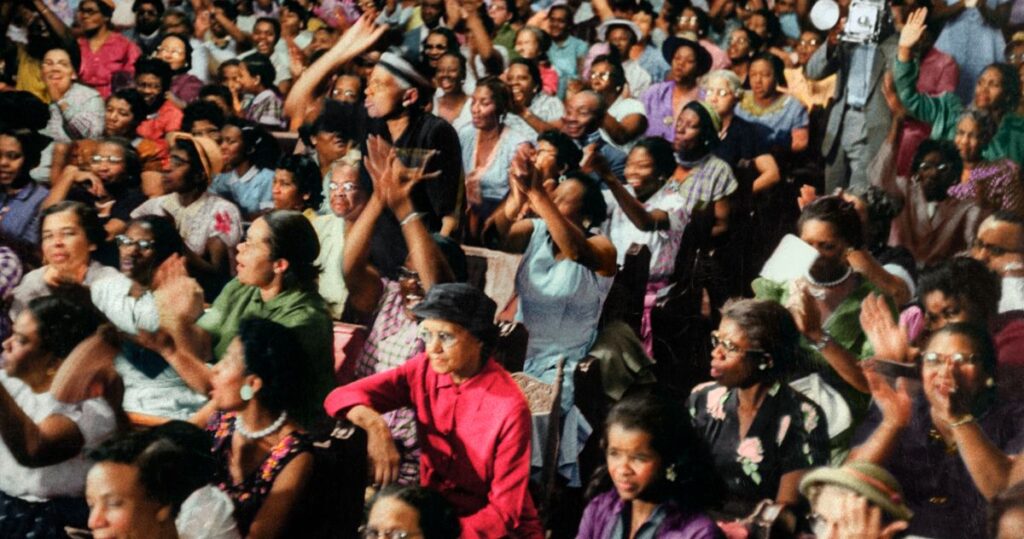
Beyond logistics, Black churches nurtured Boycott supporters’ secular and religious needs. They were places for “psychological and spiritual sustenance,” refuges from the violence and humiliation of the Jim Crow South, and incubators for group identity and solidarity.1 Henry Louis Gates Jr., The Black Church (Penguin Press, 2021), 1-2.
Interdenominational cohesion secured the support of a broad coalition of the Black community that cut across class divisions. Ministers served as leaders and spokespeople of the Boycott, emphasizing their commitment to a philosophy of nonviolence and to the struggle for integration as a moral endeavor rooted in Christian doctrine.2 King, Stride Toward Freedom, 85-86.
For the first few months of the Montgomery Bus Boycott, mass meetings were held twice a week at rotating churches throughout the city. The gatherings included songs and Scripture readings. As the president of the MIA, the Rev. Dr. Martin Luther King Jr. addressed these gatherings, where funds were collected, committees gave reports, and a different minister at each meeting delivered words of encouragement. Attendees consistently received a message of “love rather than hate” and were reminded of their mandate to “suffer violence if necessary but never to inflict it.”3 King, Stride Toward Freedom, 86-87.
Black churches in Montgomery served as pickup stations for the organized carpool effort, an elaborate network that transported tens of thousands of residents daily. Many churches also purchased station wagons for the carpool. These “rolling churches,” as they were called, were proudly emblazoned with the congregations’ names and driven by volunteers, oftentimes parishioners and pastors.
As the Montgomery Bus Boycott continued, Black churches and their parsonages became targets of white retribution. In January 1956, Dr. King’s home was bombed with his wife and infant daughter inside. The Rev. Robert Graetz’s parsonage was bombed in August of the same year.
Just weeks after the Montgomery Bus Boycott concluded with the integration of city buses in December 1956, a number of Black churches were bombed, including Bell Street Baptist Church, Hutchinson Street Baptist Church, Mt. Olive Baptist Church, and First Baptist Church, and bombs exploded at the homes of the Rev. Ralph David Abernathy and (for the second time) Rev. Graetz.4 Hy Brown, “Blast Clues Probed, Buses Still Halted,” Alabama Journal (Montgomery), Jan. 11, 1957.
Speaking to an overflowing crowd at St. John AME Church at the last mass meeting of the Montgomery Bus Boycott on December 20, 1956, Dr. King reflected on the yearlong commitment and sacrifice that made possible the Supreme Court mandate to integrate the buses.
Dr. King evoked the Boycott supporters’ faith as a sustaining force. “It is my firm conviction that God is working in Montgomery,” he said. “Let all men of goodwill, both Negro and white, continue to work with Him. With this dedication we will be able to emerge from the bleak and desolate midnight of man’s inhumanity to man to the bright and glittering daybreak of freedom and justice.”5 King, Stride Toward Freedom, 172.