Sidebar
Forerunners of Rosa Parks
Rosa Parks’s courageous refusal to give up her seat to a white person on a Montgomery city bus on December 1, 1955, drew the nation’s attention to the longstanding humiliation, harassment, and abuse of Black people on public transportation in the South.
Black women rode the bus in greater numbers than men, and as a result, were the primary targets for mistreatment on public transportation during the era of segregation. The norms of the racial order permitted white men to cross into the “Jim Crow” sections of transportation to harass Black women riding alone—and women who attempted to resist were typically demeaned and often threatened with violence.1 John K. Bollard, Protesting With Rosa Parks (NewSouth Books, 2025), 154.
Countless Black people across the U.S. nonetheless undertook great personal risk to challenge segregated transportation in the century before the Montgomery Bus Boycott. Many of these pioneers were women.
These protests began with the efforts of free Black people in the North before the Civil War. One of the earliest documented acts of resistance to transportation segregation took place in November 1832, when Harriet Mundrucu, a free Black woman from Boston who was active in the abolition movement, presented tickets for herself and her infant daughter for the “ladies’ cabin” of a boat, but was denied access because she was Black.
When Ms. Mundrucu objected, the white captain forced her off the boat, despite her having paid the highest-priced ticket. Ms. Mundrucu and her husband filed a lawsuit against the captain and were awarded $125 for breach of contract. But the captain appealed, and the Massachusetts Supreme Judicial Court overturned the award, ruling that Black people had no specific right to access the ladies’ cabin.2 Mariana Schreiber, “The Black Immigrant Who Challenged US Segregation—Nearly 190 Years Ago,” BBC, July 24, 2021; Bollard, Protesting With Rosa Parks, 1-3.
A decade later, on September 30, 1841, Mary Newhall Green, a Black woman who served as secretary of the Lynn Anti-Slavery Society, boarded a train in Lynn, Massachusetts, headed to Boston with her five-month-old infant. After she entered the first-class car, which she paid for, the conductor ordered her to use the “negro car” instead. When she refused, the conductor and five other white men violently forced Ms. Green and her infant child off the train. Afterward, Ms. Green wrote a letter to the railroad officials. “I think I have a right, in common with others, to go in any car I choose,” she wrote.3 Bollard, Protesting With Rosa Parks, 43-45.
On July 16, 1854, Elizabeth Jennings Graham attempted to board a segregated white streetcar in New York City on her way to the First Colored American Congregational Church, where she was the organist. The white streetcar driver insisted she wait for the trailing—and already full—Black segregated car. When Ms. Jennings persisted in explaining her need to get to her destination quickly and tried to board, the driver and a nearby policeman dragged her from the car and pushed her into the street with such force that a companion of hers feared they might kill her. Ms. Jennings succeeded in her legal challenge against the Third Avenue Railway Company’s policy. She was awarded $225 in damages and the company desegregated its streetcars the next day, paving the way for integrated public transportation in New York City.4 “Elizabeth Jennings Graham,” New York Transit Museum, accessed Feb. 11, 2026; Bollard, Protesting With Rosa Parks, 86-90.
In October 1865, legendary Underground Railroad conductor Harriet Tubman was working as a nurse in the U.S. Army and had been riding on a train with a government-provided half-price ticket between Philadelphia and New York. The conductor came to take her ticket, but ordered her out, telling her, “We don’t carry n—–s for half fare.” After she told the conductor she was a government employee and was entitled to ride in the same car with U.S. soldiers, she was assaulted and thrown into the “negro car” by the train conductor and three other white men, who broke her arm.5 Bollard, Protesting With Rosa Parks, 123.
On June 6, 1896, Alice A. Bowie, a Black Sunday school teacher who was escorting a large group of children to a picnic, was injured after being violently removed from a segregated streetcar in Birmingham, Alabama. When she sued the streetcar company, the Alabama Supreme Court, citing the recently decided Plessy v. Ferguson, ruled that “the carrier’s right of property…and the public interest is best subserved by a separation of negro and white passengers.”6 Bollard, Protesting With Rosa Parks, 189; Bowie v. Birmingham Railway & Elec. Co., 27 So. 1016, 1021 (Ala. 1900).
On July 16, 1944, Irene Morgan was returning home to Baltimore on a Greyhound bus after visiting her mother in Virginia. The driver demanded that Ms. Morgan vacate her seat for a white person. When Ms. Morgan refused to do so, a sheriff’s deputy forcefully removed her from the bus. Ms. Morgan was arrested and charged with resisting arrest. Although she pleaded guilty and paid the $100 fine for resisting arrest, she refused to pay a $10 fine for violating a Virginia law requiring segregated seating on public transportation. Ms. Morgan appealed the fine, and in Morgan v. Virginia, the Supreme Court ruled in her favor, invalidating state laws requiring segregation in interstate motor travel.7 Equal Justice Initiative, “July 16, 1944: Irene Morgan Arrested in Virginia for Refusing to Give Up Seat for White Passenger,” A History of Racial Injustice, accessed Feb. 11, 2026; Bollard, Protesting With Rosa Parks, 253-256.
On August 2, 1952, Pfc. Sarah Louise Keys, who served in the U.S. Army, was ordered to give up her seat to a white Marine on a bus in Roanoke Rapids, North Carolina. After she refused, she was arrested and charged with disorderly conduct. Pfc. Keys filed a complaint against the bus company with the Interstate Commerce Commission (ICC), challenging the company’s internal segregation policy as a violation of federal law. The ICC ruled in Pfc. Keys’s favor, holding that Plessy v. Ferguson’s separate-but-equal rule no longer applied to interstate travel after Brown v. Board of Education and thus closing a loophole that had allowed Southern carriers to continue discriminating in interstate travel after the Morgan v. Virginia decision.8 Kelly Agan, “Keys, Sarah,” NCpedia, updated 2019; Bollard, Protesting With Rosa Parks, 285-290.
Seventeen months before the start of the Montgomery Bus Boycott, 20-year-old Sarah Mae Flemming was assaulted by a white bus driver for sitting in the “white-only” section of a segregated bus in Columbia, South Carolina. Ms. Flemming filed a lawsuit against the bus company challenging the local segregation ordinance. She won a legal victory when a federal appellate court determined that segregation on local buses was no longer constitutional after Brown v. Board of Education, but when the case was sent back for trial, an all-white, all-male jury refused to award any compensation for the harm she suffered. Ms. Flemming’s case led to some municipalities desegregating their public buses, but the ruling was ignored in Montgomery and many other parts of the South. Nevertheless, it helped lay the foundation for the success of the Montgomery Bus Boycott.9 Steve Lesher, “Negroes Will Continue Boycott of City Lines,” Montgomery Advertiser, April 25, 1956; “Sarah Mae Flemming,” Historic Columbia and Women’s Rights and Empowerment Network, accessed Feb. 2, 2026.
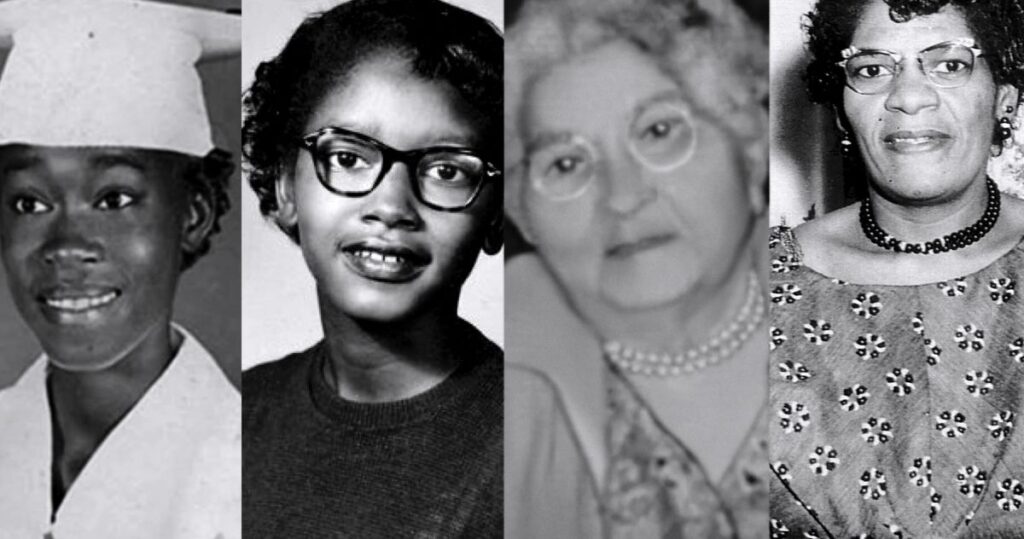
Rosa Parks’s arrest was the culmination of a series of arrests of Black bus riders in Montgomery, including the four plaintiffs of Browder v. Gayle—Claudette Colvin, Aurelia Browder, Mary Louise Smith, and Susie McDonald—and her defiance of discriminatory treatment on public transportation opened a new chapter in the long struggle for equal treatment undertaken by generations of Black people.