Sidebar
The 1900-1902 Montgomery Streetcar Boycott
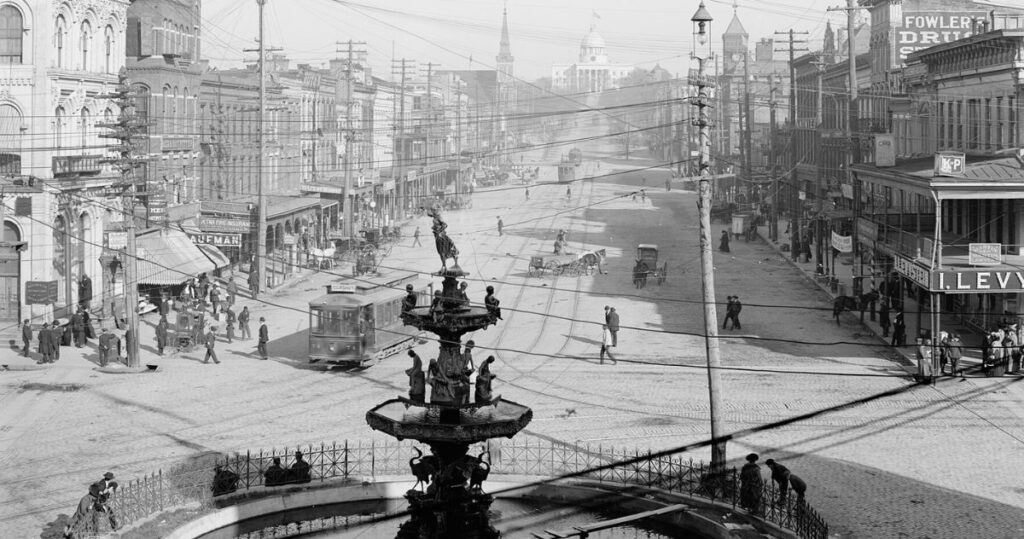
Decades before the Montgomery Bus Boycott, Black residents in Montgomery organized to protest the city’s first segregated transit ordinance. Similar protests took place in more than 25 other Southern cities at the start of the 20th century. These movements arose in response to the passage of streetcar segregation laws and ordinances at the end of the 19th century that, while initially limited to certain counties and cities, were eventually enforced statewide in Alabama and nine other Southern states.1 August Meier and Elliot Rudwick, “The Boycott Movement Against Jim Crow Streetcars in the South, 1900-1906,” The Journal of American History 55, no. 4 (March 1969): 756-757. According to Meier and Rudwick, Louisiana, Mississippi, Virginia, Tennessee, Florida, Texas, Oklahoma, and North Carolina passed statewide transportation segregation legislation in the first decade of the twentieth century, while in South Carolina and Alabama, city ordinances and streetcar company regulations similarly made segregation the enforced norm.
An electric streetcar system—the first in the U.S.—was established in Montgomery in 1886. On August 6, 1900, after a campaign by the local white press, the Montgomery City Council unanimously passed an ordinance that required separate accommodations for Black and white passengers on streetcars.2 Scotty Kirkland, “Retrospect: The Lightning Route,” Business Alabama, Sept. 24, 2024; “Will Separate Races on Cars,” Montgomery Advertiser, Aug. 7, 1900.
The ordinance mandated that streetcar employees separate passengers by race, with limited exceptions, and gave conductors and other employees police authority to enforce its provisions.
Passengers who refused to comply could be fined up to $100 and employees who failed to enforce the ordinance were likewise subject to hefty fines.3 “Will Separate Races on Cars.”
To comply with the law’s segregation requirements, Montgomery’s streetcar company designated seats in the front of the cars for white passengers and forced Black passengers to sit in the back.4 “Montgomery Negroes Boycott Street Cars,” Atlanta Constitution, Aug. 16, 1900.
In Southern cities, segregated seating served as a physical representation of racial subordination, serving not only to separate Black passengers from white ones, but to transform everyday transit into a site of humiliation and control.5 Blair L.M. Kelley, Right to Ride (University of North Carolina Press, 2010), 87.
The mobilization of Montgomery’s Black residents in response to the law was swift. Catalyzed in large part by preachers who encouraged their congregations to walk where possible, and supported by Black “hackmen and draymen”—private horsecart drivers who transported passengers and goods—this collective resistance quickly and significantly reduced the city’s Black streetcar ridership and put financial pressure on the streetcar company.6 “Cars Not Boycotted,” Montgomery Advertiser, Aug. 16, 1900; Meier and Rudwick, “Boycott Movement,” 764; “Montgomery Negroes Boycott Street Cars;” “Streetcar Receipts Fall Off,” Atlanta Constitution, Sept. 20, 1900.
The boycott, which lasted from 1900 to 1902, was unprecedented in its length and scope, and achieved a significant but temporary victory. In 1902, the city’s streetcar company suspended enforcement of the ordinance. Four years later, a new ordinance reinstituted segregated accommodations.7 Meier and Rudwick, “Boycott Movement,” 763, 774-775; “Streetcar Receipts Fall Off;” “For Separate Cars,” Montgomery Advertiser, Oct. 18, 1906.
The streetcar system in Montgomery was ended soon after a public bus service was established in the city in 1935.8 Kirkland, “Retrospect.”
The mobilization and activism of Montgomery’s Black residents during the streetcar boycott laid important groundwork for the historic Montgomery Bus Boycott.